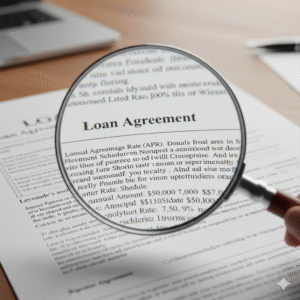
5 mistakes to make when taking out a loan

In the modern financial landscape, debt is a double-edged sword. Used correctly, a loan is a powerful lever that can help you buy a home, start a business, or navigate a temporary crisis. Used incorrectly, it is a shackle that can restrict your freedom for decades.
According to global financial data, household debt is at an all-time high. However, the problem isn’t necessarily that people are borrowing; it is how they are borrowing. The banking system is designed to be complex. It relies on jargon, fine print, and psychological triggers to maximize profits for the lender—often at the expense of the borrower.
If you are considering signing on the dotted line, you need to pause. The difference between a smart financial move and a disaster often comes down to five specific errors.
This extensive guide will dismantle the 5 most common mistakes borrowers make. We will move beyond the basics and explore the mathematics and psychology behind these errors, ensuring that when you do borrow, you do so on your own terms.
Mistake #1: Fixating on the Monthly Payment While Ignoring the Total Cost

This is the “Cardinal Sin” of borrowing, yet it is the trap most people fall into.
When you walk into a car dealership or a bank, the salesperson’s first question is almost always: “How much can you afford to pay each month?”
This question is a trap. By answering it, you hand them the keys to manipulate the loan in their favor.
The “Term Extension” Trick
If you say you can afford $400 a month, the lender can make almost any loan fit that number. How? By extending the Term (the length of the loan).
-
The Scenario: You want to borrow $20,000.
-
Loan A (3 Years): Monthly payment is roughly $600. Total interest paid: $1,800.
-
Loan B (6 Years): Monthly payment drops to $330. Total interest paid: $3,900.
The Mistake: You choose Loan B because the monthly payment is lower.
The Consequence: You end up paying double the interest. Furthermore, because you are paying the principal down so slowly, you risk becoming “underwater” on the asset (owing more than it is worth) for years.
The Fix: Never negotiate based on the monthly payment. Negotiate the Total Cost of Borrowing. Ask yourself: “Am I willing to pay $24,000 for a $20,000 item?” If the answer is no, walk away.
Mistake #2: Confusing the Interest Rate with the APR
You see an advertisement: “Personal Loans starting at 5% Interest!”
You apply, get approved, and sign the papers. But when you look at the final paperwork, the cost seems much higher. What happened?
You fell for the marketing number (Interest Rate) and ignored the real number (APR).
Understanding the Difference
-
Interest Rate: This is the cost of borrowing the principal amount. It does not include fees.
-
APR (Annual Percentage Rate): This is the interest rate PLUS all the fees required to get the loan (Origination fees, closing costs, broker fees, etc.).
Why It Matters:
Some lenders—especially in the online and subprime space—will offer a low interest rate to lure you in, but slap a massive “Origination Fee” on the loan.
-
Example: You borrow $10,000. The lender charges a 5% origination fee ($500). You only receive $9,500 in your bank account, but you pay interest on the full $10,000.
The Fix: The APR is the only number that allows you to compare “apples to apples.” If Lender A offers 6% Interest with high fees, and Lender B offers 7% Interest with zero fees, looking at the APR will reveal which one is actually cheaper.
Mistake #3: Accepting the First Offer (The Loyalty Tax)

Humans are creatures of habit. When we need money, our instinct is to walk into the bank where we have kept our checking account for 10 years. We assume that because we are loyal customers, they will give us the best deal.
In the banking world, loyalty is rarely rewarded. In fact, it is often exploited. This is known as the “Loyalty Tax.” Banks know that existing customers are less likely to shop around, so they often offer standard rates rather than competitive ones.
The Competition Gap
The lending market is vast. It includes:
-
Big Banks: Often have the strictest requirements and highest fees.
-
Credit Unions: Non-profit organizations that typically offer lower rates and better terms.
-
Online Lenders (Fintech): Have low overhead costs (no physical branches) and use algorithms to approve loans quickly, often at very competitive rates.
The Fix: Treat a loan like a flight ticket. You wouldn’t buy the first flight you see; you compare. Get quotes from at least three different sources. Often, you can take a quote from an online lender to your local bank and ask them to match it. If they want your business, they will.
Mistake #4: Ignoring the “Prepayment Penalty” Clause
Imagine this: Two years into your five-year loan, you get a promotion at work or receive a bonus. You decide to be responsible and pay off the rest of your loan early to save on interest.
You send the check, and the bank hits you with a massive fee.
This is the Prepayment Penalty.
Why Does It Exist?
Lenders make their profit on interest over time. If you pay the loan off early, they lose that future profit. To protect themselves, many lenders include a clause in the fine print that penalizes you for paying off the debt ahead of schedule.
The Trap:
Some penalties are calculated as a percentage of the remaining balance (e.g., 2% or 3%). On a large loan, this can wipe out any savings you gained by paying early.
The Fix: Before signing any loan document, ask specifically: “Is there a penalty for paying this loan off early?” If the answer is yes, look for another lender. In the modern market, there are plenty of lenders who offer “No Prepayment Penalty” loans. You should always retain the freedom to get out of debt.
Mistake #5: Borrowing for “Wants” Instead of “Needs” (Good vs. Bad Debt)
The final mistake is not mathematical; it is philosophical. It is the error of using debt to fund a lifestyle you cannot afford.
Financial experts categorize debt into two buckets:
Good Debt
Money borrowed to purchase an asset that will appreciate in value or generate income.
-
Examples: A mortgage (builds equity), a student loan (increases earning potential), or a business loan (generates profit).
-
Verdict: This debt pays for itself over time.
Bad Debt
Money borrowed to purchase a depreciating asset or a fleeting experience.
-
Examples: A loan for a wedding, a vacation, luxury furniture, or a car that is too expensive for your budget.
-
Verdict: You are paying interest on something that is losing value. This is a double loss.
The Consequence:
When you borrow for consumption, you are stealing from your future self. You are committing future hours of labor to pay for a pleasure that has already passed. This leads to the “Debt Trap,” where you eventually have to borrow more just to keep up with payments.
The Fix: Apply the “Sleep Test.” If you cannot pay cash for a luxury item, you cannot afford it. Save for it instead. Reserve your borrowing power for assets that build your net worth, not your status.
Bonus: The Hidden Role of Your Credit Score
Underlying all these mistakes is the foundation of your borrowing power: Your Credit Score.
Many people apply for a loan without knowing their score. This is like walking into a negotiation blindfolded.
-
750+ Score: You command the market. You get the lowest rates and the best terms.
-
Sub-600 Score: You are at the mercy of the lender. You will be offered predatory rates and high fees.
Pro Tip: Before applying, download your credit report. Check for errors. Sometimes, paying down a small credit card balance can boost your score by 20 points in a month, moving you into a better tier and saving you thousands of dollars on your new loan.
Be the CEO of Your Finances
Taking out a loan is a business transaction. The bank is selling you a product (money), and you are the buyer.
When you walk into a store to buy a television, you check the specs, compare the price, and read the warranty. You must do the same with money. By avoiding these five common mistakes—ignoring the total cost, confusing APR, failing to shop around, missing the fine print, and borrowing for the wrong reasons—you shift the power dynamic.
Debt doesn’t have to be a disaster. If you approach it with caution, skepticism, and a calculator, it can be the fuel that propels you to the next level of financial success.