How Inflation Affects Loan Interest Rates
If you’ve tried to get a loan in the last few years, you’ve probably felt the “sticker shock.”
You go to a car dealership, and the 7% APR offer on a new car loan makes your eyes water—especially when you remember your friend getting a 3% rate just a few years ago. You check mortgage rates, and they’re double what they were. Even your credit card’s “variable APR” has been ticking upward in a way that feels personal.
What is going on? Is it greed? Is it a conspiracy?
The answer is simpler and far more powerful: Inflation.
That single word—which most of us just associate with gas and grocery prices—is the “master controller” for almost every interest rate in the economy. The relationship between the price of bread and the cost of your car loan is one of the most important, and least understood, concepts in personal finance.
This guide will break down that relationship in simple, human terms. We’ll explain why this happens, who’s pulling the levers, and what it means for your mortgage, your auto loan, and your credit card.
What is Inflation, in Simple Terms?
Before we can connect the dots, let’s start with the basics.
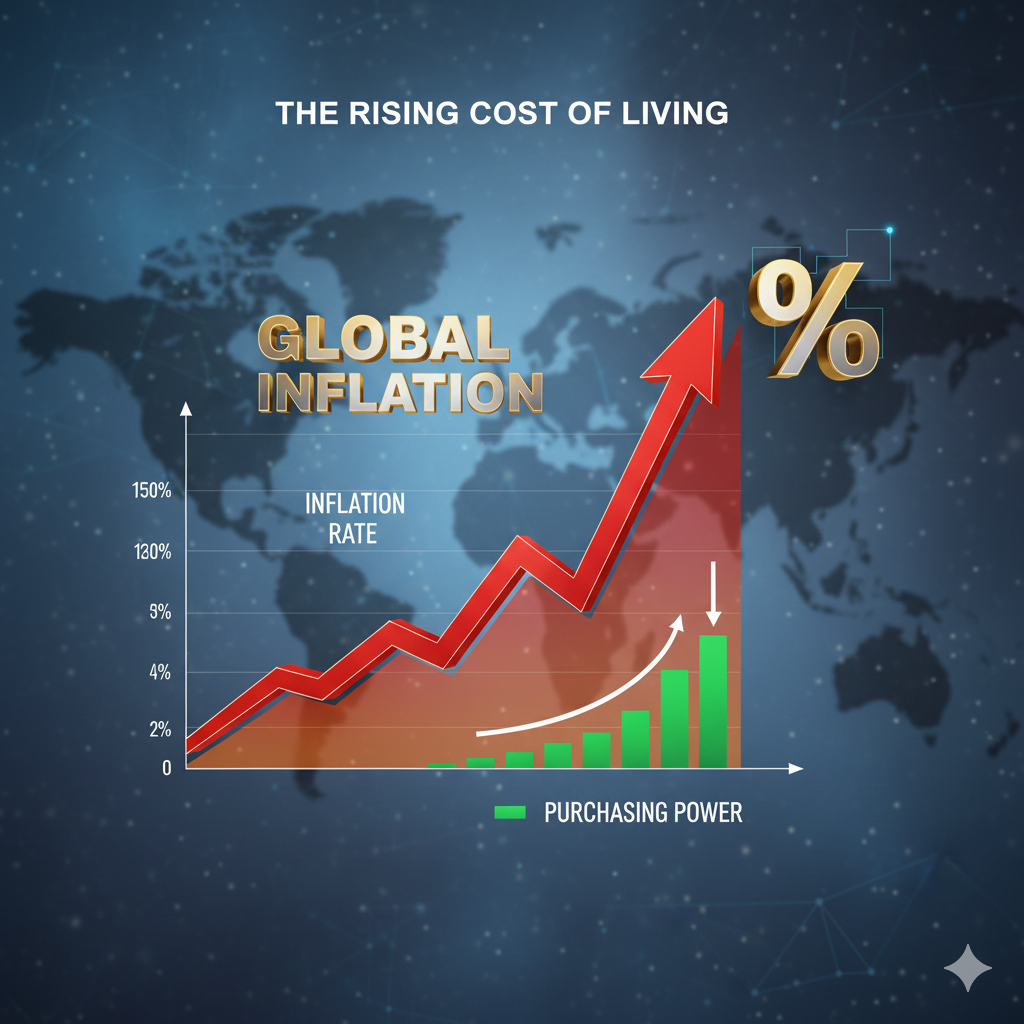
Inflation is the decline of your money’s purchasing power over time.
It’s the reason your grandparents tell stories about buying a candy bar for a nickel. It’s not that candy bars got better; it’s that the dollar got weaker.
Think of it as an invisible tax on your cash. If you have $100 in a cookie jar, and inflation for the year is 5%, your $100 will only buy you $95 worth of “stuff” next year.
When inflation is high, the cost of everything—food, fuel, housing, cars—goes up, fast. Your paycheck doesn’t go as far, and everyone starts to feel poorer.
What is an Interest Rate?
Now for the other side of the coin.
An interest rate is the “price” you pay to rent money.
When you take out a loan, you are “renting” a lump sum of money from a lender. The interest is the “rent” you pay them for the privilege of using their money now, instead of later.
From the lender’s perspective, the interest rate is their reward for two things:
- Taking a risk: They are trusting that you will pay them back.
- Delaying their own spending: They can’t use that money while you have it.
The Lender’s Dilemma: The Core Link Between Inflation and Interest
Here is the single most important concept you need to understand. This is the “Aha!” moment.
Lenders are not stupid. They are in the business of making a real profit. They are just as afraid of inflation as you are.
Let’s imagine a simple scenario:
- You go to a bank (your friend, Bob) and ask for a $10,000 loan for one year.
- Bob the Banker wants to make a 3% profit. So, he gives you a loan at 5% interest.
- At the same time, the inflation rate is 2%.
At the end of the year, you pay Bob back $10,500 (your $10,000 principal + $500 in interest). Bob feels great. He made 5% on his money, right?
Not quite. Because of that 2% inflation, the $10,500 he gets back is only worth $10,290 in “last year’s money.” His real profit—his gain in actual purchasing power—was only $290, or 2.9%. He’s still happy.
Now, let’s change the scenario. Inflation is high.
- Bob gives you the same $10,000 loan at 5% interest.
- But this time, the inflation rate is 8%.
- At the end of the year, you pay him back $10,500.
- But because of 8% inflation, that $10,500 is only worth $9,660 in “last year’s money.”
Bob the Banker lost money. He gave you $10,000 in purchasing power and you returned $9,660 in purchasing power. He would have been better off just buying a boat.
This is why lenders must charge an interest rate that is higher than the expected rate of inflation. The difference between the rate on your loan (the “nominal rate”) and the inflation rate is the lender’s “real interest rate”—their actual profit.
Nominal Rate (10%) – Inflation (7%) = Real Interest Rate (3%)
When inflation spikes, lenders everywhere must raise their interest rates to protect themselves from losing money.
The “Master Controller”: How The Federal Reserve Fights Inflation

So, lenders raise rates to protect their profits. But there’s a much bigger, more powerful force at play: The Federal Reserve.
The Federal Reserve (or “The Fed”) is the central bank of the United States. It has a “dual mandate” from Congress:
- Keep prices stable (i.e., control inflation, ideally around 2%).
- Maintain maximum employment.
When inflation is low and the economy is weak, the Fed lowers interest rates to encourage spending and hiring. But when inflation gets high (like it has recently), the Fed has to slam on the brakes.
The Fed’s “Big Red Button”: The Federal Funds Rate
The Fed has one main tool to fight inflation: the Federal Funds Rate.
This isn’t an interest rate you ever pay. It’s the “wholesale” interest rate that banks charge each other for overnight loans to meet their reserve requirements.
Think of it as the “master cost of money.” When the Fed “raises interest rates,” they are raising this rate. And when the wholesale cost of money goes up for banks, the retail cost of money (your loan) goes up, too.
The Chain Reaction: How One Rate Hike Affects Your Wallet
This is how that one, obscure rate change in Washington D.C. makes your car loan more expensive.
- Inflation is High: The Fed sees inflation at 6%. This is way too high.
- The Fed Acts: The Fed’s committee (the FOMC) holds a meeting and announces: “We are raising the Federal Funds Rate by 0.50%.”
- Banks Feel the Squeeze: It is now 0.50% more expensive for your local bank to do business and borrow money from other banks.
- The Prime Rate Rises: To protect their profits, big banks immediately raise their own “Prime Rate.” The Prime Rate is the base rate they offer to their best corporate customers.
- Your Loans Get More Expensive: This is where it hits you.
- Credit Cards & HELOCs: These are directly tied to the Prime Rate. Your credit card agreement has fine print that says your APR is “Prime Rate + 15.99%.” When the Prime Rate goes up 0.50%, your credit card APR automatically goes up 0.50% within a month or two.
- Auto Loans & Personal Loans: When a bank prices a new 5-year auto loan, they look at the new, higher cost of money and price that in. The 3% rates vanish and are replaced with 7% rates.
- Mortgages (The Special Case): This one is a bit different. Mortgage rates are not directly tied to the Fed’s rate. They are tied to the 10-Year Treasury bond, which is what investors buy. However, investors are “forward-looking.” The moment the Fed even signals it’s going to fight inflation, investors sell bonds, which makes bond yields (and mortgage rates) spike. This is why mortgage rates can rise before the Fed even acts.
Why Does This “Cure” Inflation? (The “Cooling Off” Effect)
So, why does the Fed want you to pay a higher loan rate? Are they just mean?
No. They are trying to “cool off” the economy. High inflation is caused by too much money chasing too few goods. The Fed’s actions are designed to reduce demand.
- You at 3% Mortgages: “Let’s buy a house! It’s cheap to borrow!” (High Demand)
- You at 8% Mortgages: “Let’s just keep renting.” (Low Demand)
- You at 2% Auto Loans: “I’m going to get a new truck!” (High Demand)
- You at 9% Auto Loans: “My 10-year-old sedan is running just fine.” (Low Demand)
- You with a 2% Savings Account: “Why save? I should spend my money.” (High Demand)
- You with a 5% Savings Account: “Wow, I should save more money. I get a great return!” (Low Demand)
When people and businesses stop borrowing and spending, demand for houses, cars, and other goods falls. When demand falls, companies can’t raise prices anymore. They might even have to cut them.
This is the “medicine” for inflation. The fever is high prices. The medicine is high interest rates. The medicine tastes bad (it can cause a recession), but it’s designed to cure the fever.
How Does Inflation Affect Existing Loans? (Fixed vs. Variable)

This is the most practical question of all. What happens to the loans you already have?
Fixed-Rate Loans (You are SAFE)
If you have a fixed-rate loan, you are a winner in the inflation game.
- Loans: 30-year fixed mortgage, 5-year fixed auto loan, fixed-rate personal loan.
- What Happens: Absolutely nothing. You locked in that sweet 3% mortgage rate back in 2021, and you get to keep paying that same payment for the next 30 years, even as inflation rages.
- The Bonus: You are paying the bank back with weaker, inflated dollars. Your $1,500 mortgage payment feels a lot cheaper when your salary has (hopefully) gone up with inflation. You “beat” the bank.
Variable-Rate Loans (You are EXPOSED)
If you have a variable-rate loan, you are on the front lines, and you are losing.
- Loans: Credit cards, Home Equity Lines of Credit (HELOCs), Adjustable-Rate Mortgages (ARMs).
- What Happens: As we saw, these are directly tied to the Prime Rate. When the Fed raises rates, your rate will go up. That 5% HELOC you took out last year could become a 9% HELOC this year. Your minimum payment will increase, and more of your payment will go to interest.
- The Danger: This is how people get into debt spirals. The credit card you’re trying to pay off is now charging you more interest, making it harder to pay off.
What Can You Do About It? (Your Financial Action Plan)
You can’t control the Fed, and you can’t control inflation. But you can control your own finances. Here’s what to do when rates are rising.
- Attack Variable-Rate Debt: That credit card debt is no longer just a problem; it’s a five-alarm financial fire. Every time the Fed raises rates, your debt gets more expensive. Make it your #1 priority to pay this off. Consider a fixed-rate debt consolidation loan (if you can get a good rate) to “lock in” the interest.
- Lock in Fixed Rates (If You Must Borrow): If you absolutely must buy a car or get a loan, fight for a fixed-rate loan. Do not get tricked by a “low” teaser variable rate. You want predictability.
- Find the Silver Lining: Boost Your Savings. There is one group of people who loves when the Fed raises rates: savers. For the first time in over a decade, High-Yield Savings Accounts (HYSAs) and Certificates of Deposit (CDs) are paying fantastic rates (4-5%+). The Fed is rewarding you for saving. Take advantage of it.
- Improve Your Credit Score. This is your only defense. A high FICO score (760+) won’t get you a 3% rate in a 7% world. But it will get you the 7% rate while everyone else is being offered 12%. A great credit score ensures you are always offered the best possible rate in any environment.
Inflation and Interest are a Seesaw

The relationship is simple: When inflation goes up, interest rates follow.
This isn’t a random event. It’s a deliberate, mechanical process, started by lenders protecting their profits and amplified by the Federal Reserve to “cool down” the entire economy.
The high loan rates you’re seeing are the “medicine” to “cure” the “fever” of high prices. Your job as a smart consumer is to understand this, protect yourself from variable-rate debt, and take advantage of the high rates on your savings.