How does the government impact stock prices?

When most new investors think about what moves a stock, they focus on the company itself. Did they launch a hit product? Did they have a great earnings report? Is their CEO a visionary? These are all critical factors.
But there is a silent, powerful partner in every single trade you make. This entity can change the rules of the game at any moment, send one industry soaring while crushing another, and single-handedly dictate the mood of the entire market.
That entity is the government.
From Washington D.C. to your state capital, the decisions made by politicians, regulators, and central bankers have a profound and unavoidable impact on your investment portfolio. For investors, ignoring the government is like a ship captain ignoring the weather.
Understanding how these actions ripple through the economy is the key to becoming a smarter, more prepared investor. You don’t need a political science degree, but you do need to understand the basic “levers” the government can pull. This guide will break them all down in plain English.
The Federal Reserve: How Interest Rate Policy Becomes Everyone’s Business

If the U.S. economy is a car, the Federal Reserve (the “Fed”) is the driver with their foot on the gas and brake pedals. The Fed is the central bank of the United States, and its main job is to manage the country’s monetary policy.
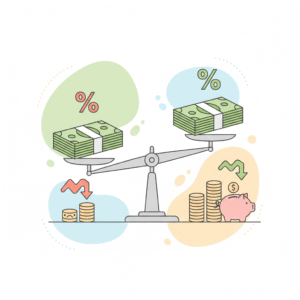
The Fed’s most powerful tool is the federal funds rate, which is the interest rate at which banks lend to each other overnight. This rate sets the baseline for all other interest rates in the economy—from your mortgage and car loan to your credit card APR and, crucially, the loans that businesses use to grow.
When the Fed Hits the Brakes (Raising Interest Rates)
When the economy is “too hot” and inflation is rising (like we saw in 2022-2023), the Fed “hits the brakes” by raising interest rates.
This has several massive, negative effects on stock prices:
- “Safe” Money Looks Better: When you can get a 5% guaranteed return from a high-yield savings account or a U.S. Treasury bond, why would you take the risk of the stock market for a potential 8-10%? This pulls billions of dollars out of the stock market and into “safer” assets, causing stock prices to fall. This is often called “TINA” (There Is No Alternative) in reverse.
- Business Becomes More Expensive: Companies that want to build a new factory, develop a new product, or hire more people often borrow money to do it. When rates are high, these loans are more expensive, which eats into their profits and slows down their growth.
- Growth Stocks Get Crushed: High-growth technology stocks (like those in the Nasdaq) are especially sensitive. Their value is based on profits they hope to earn far in the future. When rates are high, those future profits are “discounted” more heavily, making them worth less today.
When the Fed Hits the Gas (Lowering Interest Rates)
When the economy is weak or in a recession (like during the 2008 financial crisis or the 2020 pandemic), the Fed “hits the gas” by lowering interest rates.
This is generally fantastic for stock prices:
- “Safe” Money Looks Terrible: When a savings account pays 0.1%, investors are “forced” to find a better return elsewhere. This pushes billions of dollars into the stock market, looking for any kind of growth. This is the classic “TINA” (There Is No Alternative) environment that can fuel bull markets.
- Business Becomes Cheap: Companies can borrow money for next to nothing, fueling innovation, stock buybacks, and expansion, all of which tend to boost profits and stock prices.
The takeaway: Don’t just watch your stocks; watch the Fed. “Don’t fight the Fed” is one of the oldest adages on Wall Street for a reason.
Understanding Fiscal Policy: How Government Spending and Taxes Shape Markets
If the Fed controls monetary policy (interest rates), Congress and the White House control fiscal policy. This is a fancy term for the government’s two other levers: spending and taxation.
Government Spending as an Investment
The U.S. government is the single largest customer in the world. Where it decides to spend its trillions of dollars creates clear winners.
- Defense Spending: A $900 billion defense bill is a direct, guaranteed revenue stream for defense contractors like Lockheed Martin ($LMT), Northrop Grumman ($NOC), and RTX ($RTX).
- Infrastructure Projects: A major infrastructure bill (like 2021’s Bipartisan Infrastructure Law) means billions for companies that build roads, bridges, and grids. Think construction firms ($CAT), materials suppliers ($VMC), and engineering companies.
- Subsidies and Tax Credits: The government can literally “pay” companies and consumers to adopt a new technology. The Inflation Reduction Act (IRA), for example, provided massive subsidies for buying electric vehicles ($TSLA, $F, $GM) and installing solar panels ($ENPH, $SEDG). This is the government actively creating a market.
- The CHIPS Act: This 2022 law is a perfect example. The government is giving billions of dollars directly to semiconductor companies like Intel ($INTC), Micron ($MU), and Samsung to build fabrication plants in the U.S. This is a direct boost to their bottom line.
Tax Policy and Your Profits
Taxes are the other side of the coin. Changes in the tax code can instantly change a company’s profitability.
- Corporate Tax Rates: The 2017 Tax Cuts and Jobs Act, which slashed the corporate tax rate from 35% to 21%, was a massive, immediate boost to corporate profits. When a company’s after-tax profit instantly jumps, its stock price often follows. Any talk of raising this rate will have the opposite effect, causing markets to get nervous.
- Capital Gains Taxes: This is the tax you pay on your investment profits. If the government proposes a steep hike in the capital gains tax, it might incentivize investors to sell their winners before the new rate takes effect, causing a short-term market sell-off.
The Power of the Pen: How Regulations Can Create or Destroy Industries

Beyond the big-picture items of spending and taxes, “alphabet soup” government agencies (FDA, EPA, FTC, SEC) write the day-to-day rules that businesses must follow. These regulations can be a minor headache or a life-or-death event for a company.
Regulation as a Wall
For some companies, regulation is a “moat” that protects them from competition. It’s so expensive and complicated to get a new drug approved by the Food and Drug Administration (FDA) that it keeps small startups out, benefiting large pharmaceutical giants ($PFE, $JNJ).
But this is a double-edged sword. A drug company’s stock can fall 50% in one day if the FDA rejects its new blockbuster drug.
Regulation as a Weapon
For other industries, regulation is a direct threat.
- Environmental Protection Agency (EPA): New, stricter emissions standards for cars can cost automakers billions in re-tooling and fines, hitting their profits.
- Federal Trade Commission (FTC) / Dept. of Justice (DOJ): These are the antitrust enforcers. When the government sues to block a major merger (like Microsoft’s acquisition of Activision Blizzard or JetBlue’s of Spirit Airlines), it can destroy billions in value. The threat of an antitrust lawsuit against Big Tech companies ($GOOG, $AMZN, $META) can create a “legal overhang” that weighs down their stock prices for years.
Sometimes, regulation creates an entire industry. Government mandates for clean energy, for example, are the entire foundation for the growth of many solar and wind power companies.
Global Trade Policy and Tariffs: When Geopolitics Hits Your Portfolio
A stock’s price isn’t just affected by domestic policy. It’s also vulnerable to how the U.S. government interacts with other countries.
Tariffs (aka Taxes on Imports)
A tariff is just a tax on goods imported from another country. When the U.S. imposes tariffs on, say, Chinese steel or electronics, it has complex ripple effects:
- Who It Hurts:
- U.S. companies that use those imported goods. A U.S. automaker that now has to pay 25% more for its steel will see its profits shrink.
- U.S. companies that sell to that country. China almost always responds with retaliatory tariffs on U.S. goods (like iPhones or soybeans), making them more expensive in China and hurting sales for $AAPL or $DE.
- Who It Helps (Maybe):
- Domestic companies that compete with the imports. A U.S. steel company is thrilled, as its foreign competition is now 25% more expensive, allowing it to raise its own prices.
“Trade wars” are generally bad for the entire market because they create uncertainty, raise costs, and slow down the global economy.
Sanctions and Geopolitical Conflict
Sanctions are a more extreme tool. When the U.S. and its allies place sanctions on a country (like Russia or Iran), it can instantly remove a massive supplier of a global commodity from the market. Sanctions on Russia, a huge oil and gas exporter, sent energy prices ($XOM, $CVX) skyrocketing in 2022, which in turn fueled global inflation.
Political Stability, Elections, and Market Uncertainty
Finally, the market is a giant “sentiment” machine. And there is one thing it hates more than bad news: uncertainty.
The Election Cycle
In the months leading up to a major presidential election, the market often gets “choppy” or trades sideways. Big-money investors pause, waiting to see what the new “rules of the game” will be.
- Party Platforms: Markets try to “price in” potential outcomes. Traditionally, a Republican administration is seen as pro-fossil fuels, pro-defense, and pro-deregulation (good for $XOM, $LMT, and $BAC). A Democratic administration is often seen as pro-green energy, pro-healthcare expansion, and pro-regulation (good for $NEE, $UNH, and bad for some industries).
- Gridlock is… Good? Ironically, the market’s favorite outcome is often “gridlock”—where one party controls the White House and the other controls one or both houses of Congress. Why? Because it means no extreme, sweeping, or sudden changes can be passed, preserving the status quo. Markets love predictability.
Government Shutdowns and Debt Ceilings
You’ve seen the headlines. Any time Congress flirts with a government shutdown or a debt ceiling default, the market gets terrified. A default on U.S. debt would be a global financial catastrophe. The threat alone is enough to cause sell-offs and see the U.S. credit rating downgraded, which can raise borrowing costs for everyone.
What Should a Regular Investor Do About All This?

You’ve just read a long list of complex, unpredictable, and powerful forces. It might seem impossible to invest when the government holds so many cards.
So, what’s the solution? It’s not to become a political expert or a day trader who buys and sells on C-SPAN hearings.
The solution is diversification.
The reason a broad-market index fund (like an S&P 500 ETF) is the most recommended investment for most people is that it’s the ultimate defense against all this political risk.
When you own an S&P 500 fund, you own a tiny piece of all 500 of the top U.S. companies.
- If a Democratic administration’s policies hurt the oil and gas industry, they are likely helping the green energy companies which you also own.
- If tariffs hurt companies that import, they are likely helping the domestic companies which you also own.
- If high-interest rates hurt tech stocks, they are likely helping bank stocks (which earn more on their lending) which you also own.
You cannot predict what the government will do. But you can build a portfolio that is resilient enough to withstand the political weather, no matter which way the wind blows.
Your best strategy is to focus on what you can control: your savings rate, your time horizon, and your emotions. Don’t sell your entire portfolio because of a scary headline from Washington. Stick to your long-term plan, stay diversified, and let the messy, complex, and powerful engine of the U.S. economy (government and all) work for you over time.