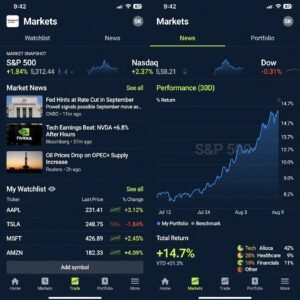
Have you heard of NASDAQ?

When you hear about the stock market, you might picture the chaotic floor of the New York Stock Exchange (NYSE), with traders in colorful jackets shouting and waving paper. But there’s another, equally powerful giant in the world of finance, one that operates silently, digitally, and is home to the companies that define our modern lives.
You use their products every day: the iPhone in your pocket (Apple), the search engine you used to find this article (Google), the cloud that stores your photos (Microsoft), and the online store that delivers packages to your door (Amazon).
All these revolutionary companies have one major thing in common: they call the NASDAQ home.
But what is the NASDAQ? Is it just a list of tech stocks? How does it work? And most importantly, what does it mean for you as an investor? This comprehensive guide will demystify one of the most important stock exchanges in the world, in simple terms anyone can understand.
What Does NASDAQ Actually Stand For?

Let’s start with the name. “NASDAQ” is an acronym, and while you’ll rarely hear it spelled out, it’s key to understanding its revolutionary origin.
NASDAQ = National Association of Securities Dealers Automated Quotations
It’s a mouthful, but the most important words are “Automated Quotations.”
When the NASDAQ was founded in 1971 by the National Association of Securities Dealers (NASD), it wasn’t a traditional stock exchange. The NYSE, which has been around since 1792, was a physical “auction market.” Buyers and sellers would gather on a central floor, and a “specialist” would manually match trades at the best price.
The NASDAQ was a radical idea. It had no physical trading floor. It was the world’s first electronic stock market, a massive computer network that connected dealers all over the country. Instead of shouting, traders could see the best available prices (the “quotations”) for a stock on a computer screen. This innovation in “automation” made trading faster, more transparent, and more efficient. It was the tech-driven disruptor of its day, which is why it naturally became the home for the tech disruptors of the future.
The NASDAQ Difference: A Digital Revolution in Trading
The core difference between the NASDAQ and its older rival, the NYSE, is how stocks are traded. This is more than just a technical detail; it defines the market’s entire character.
The NYSE: The Auction Market
Think of the NYSE like a high-end art auction. There is one “auctioneer” (called a specialist) for each stock, located at a specific “trading post” on the floor.
- Buyers and sellers send their orders to this specialist.
- The specialist’s job is to match the highest bid (buy price) with the lowest ask (sell price), facilitating a fair and orderly auction.
- This physical, human-centric system is why you see all the activity on the NYSE floor.
The NASDAQ: The Dealer’s Market (Market Makers)
The NASDAQ is a “dealer’s market,” which is more like a giant, competitive shopping mall. Instead of one specialist, a stock can have dozens of “market makers.”
A market maker is a large financial firm (like a bank or brokerage) that is obligated to publicly post two prices for a stock:
- The Bid: The price at which they are willing to buy the stock.
- The Ask: The price at which they are willing to sell the stock.
These market makers compete with each other for your business. The NASDAQ’s computer system collects all these quotes and displays the best available prices—the highest bid and the lowest ask—to the entire world. This competition is what keeps prices fair and “spreads” (the difference between the bid and ask) tight.
Because this entire system is electronic, the NASDAQ has no need for a physical trading floor. All the trading happens in fractions of a second inside computer servers located in data centers.
The Companies of NASDAQ: Why It’s Called the “Tech Hub”
When the NASDAQ launched, it attracted younger, smaller, and more speculative companies that couldn’t yet meet the strict and expensive listing requirements of the “blue-chip” NYSE. This included many innovative technology firms, like Microsoft, Apple, and Intel.
As these small tech companies grew into the largest and most influential corporations on the planet, the NASDAQ’s reputation grew with them. It became the premier exchange for innovation, growth, and technology.
Today, the list of NASDAQ-listed companies is a “who’s who” of modern America:
- Apple (AAPL)
- Microsoft (MSFT)
- Amazon (AMZN)
- Alphabet (GOOGL/GOOG) – Google
- Meta Platforms (META) – Facebook/Instagram
- NVIDIA (NVDA)
- Tesla (TSLA)
- Netflix (NFLX)
This isn’t to say only tech companies are on the NASDAQ. You’ll also find major non-tech brands like Starbucks (SBUX), Costco (COST), and PepsiCo (PEP). However, the exchange’s identity and performance are overwhelmingly driven by its tech-heavyweights.
The Dot-Com Bubble: NASDAQ’s Trial by Fire

You cannot tell the story of the NASDAQ without mentioning the dot-com bubble of the late 1990s. As excitement about the new “world wide web” reached a fever pitch, investors poured billions of dollars into any company with a “.com” in its name, regardless of whether it had a real business plan or any revenue.
The NASDAQ was the epicenter of this speculative frenzy. The NASDAQ Composite index, which measures the value of all its stocks, soared from under 1,000 points in 1995 to over 5,000 by March 2000.
Then, the bubble burst.
From March 2000 to October 2002, the NASDAQ Composite crashed by nearly 80%. Companies that were once worth billions went bankrupt, wiping out fortunes. It was a brutal and painful period, but also a critical one. It washed out the bad ideas and solidified the companies with real, sustainable businesses—like Amazon and Apple—which rose from the ashes to become today’s giants. This period cemented the NASDAQ’s reputation for both high growth and high volatility.
Understanding the NASDAQ Indexes: The Composite vs. the NASDAQ-100
This is one of the most important concepts to grasp. When you hear a news anchor say “the NASDAQ was up 100 points today,” they are almost always referring to one of two “indexes,” or “scorecards,” that track the exchange’s performance.
1. The NASDAQ Composite Index ($COMP)
- What It Is: This is the big one. The NASDAQ Composite is an index that includes almost all of the 3,000+ stocks that trade on the NASDAQ exchange.
- What It Represents: It gives you a broad, comprehensive look at the health of the entire NASDAQ market. Because the market is so tech-heavy, the Composite is often used as a benchmark for the technology sector as a whole.
- How It’s Calculated: It is “market-cap weighted.” This means the companies with the largest “market capitalization” (stock price x number of shares) have the biggest impact on the index’s movement. A 2% move in Apple (a $2+ trillion company) will move the index far more than a 20% move in a small $2 billion company.
2. The NASDAQ-100 Index ($NDX)
- What It Is: This is the more exclusive, celebrity-filled index. The NASDAQ-100 tracks the 100 largest and most actively traded non-financial companies listed on the NASDAQ.
- What It Represents: This is the true home of “Big Tech.” It excludes banks and investment firms to focus purely on the innovators in technology, retail, health care, and biotech. It includes all the names you’d expect: Apple, Microsoft, Amazon, Google, Meta, Tesla, and NVIDIA.
- What It’s Used For: This index is the basis for one of the most popular and heavily traded Exchange-Traded Funds (ETFs) in the world: the Invesco QQQ Trust (ticker: QQQ).
When you hear financial commentators talk about “Big Tech” performance, they are often looking at the NASDAQ-100.
NASDAQ vs. NYSE: The Two Titans of Wall Street
So, what’s the better exchange? It’s not about “better,” it’s about “different.” The rivalry between the NYSE and NASDAQ pushes both to innovate, but they represent two different philosophies.
| Feature | NASDAQ | New York Stock Exchange (NYSE) |
| Founded | 1971 | 1792 |
| Trading Model | Electronic Dealer’s Market (Market Makers) | Physical Auction Market (Specialist) + Electronic |
| Nickname | The “Tech Exchange,” “Home of Innovation” | The “Big Board,” “Blue-Chip Exchange” |
| Famous Companies | Apple, Microsoft, Amazon, Google, Tesla | Coca-Cola, Johnson & Johnson, Walmart, JPMorgan Chase |
| Vibe | Modern, growth-oriented, disruptive | Established, stable, “old-guard,” industrial |
| Listing Style | Popular with modern tech IPOs | Historically seen as more prestigious (though this is changing) |
In recent years, the lines have blurred. The NYSE now has its own advanced electronic trading systems, and it has successfully wooed tech IPOs. Meanwhile, the NASDAQ has attracted established “blue-chip” companies like PepsiCo. However, their core identities remain distinct.
How Does a Company Get Listed on the NASDAQ?
A company can’t just decide to be on the NASDAQ. It’s an exclusive club with strict entry requirements designed to protect investors. This is what separates it from the “over-the-counter” (OTC) or “penny stock” markets, which have very little regulation.
To get listed, a company must meet minimum financial standards. The NASDAQ actually has three different tiers for this:
- NASDAQ Global Select Market: This is the top tier, with the most stringent financial and liquidity requirements. It’s for the biggest, most established companies.
- NASDAQ Global Market: This is the mid-cap tier, still with high standards but designed for companies that are on their way to becoming large global enterprises.
- NASDAQ Capital Market: This is the “entry-level” tier (formerly called the SmallCap Market) for smaller companies that still have growth potential. They have less-stringent (but still significant) requirements for revenue and market value.
While the exact rules are complex, a company generally needs to have:
- A minimum number of public shareholders.
- A minimum number of publicly traded shares.
- A minimum stock price (e.g., $4.00 at the time of listing).
- A minimum total market value, OR minimum annual revenue, OR minimum total assets.
If a company fails to meet these standards after being listed (for example, if its stock price falls below $1.00 for too long), it can be “delisted,” or kicked off the exchange.
How Can You, the Average Investor, Invest in NASDAQ?

Reading about the NASDAQ is interesting, but how do you actually invest in it? You have two primary methods, both of which can be done through any standard brokerage account (like those from Fidelity, Schwab, or Robinhood).
Method 1: Buying Individual Stocks
This is the most direct approach. You believe in a specific company, so you buy its stock.
- Example: You think Tesla’s new battery technology is a game-changer, so you buy shares of $TSLA. Or you think Apple’s ecosystem is unbeatable, so you buy $AAPL.
- Pros: You have the potential for massive gains if you pick a winner. You have total control over what you own.
- Cons: This is high-risk. If that one company fails, you can lose a lot of money. It requires a significant amount of research to pick good companies.
Method 2: Buying Index Funds and ETFs (The “Easy” Way)
This is the most popular method for most investors. Instead of trying to find the one winning stock, you buy a single “basket” that holds all the stocks.
This is done through Exchange-Traded Funds (ETFs). An ETF is a fund that trades on the stock market just like a single stock, but it may contain hundreds or thousands of different stocks inside it.
- The NASDAQ-100 ETF (Ticker: $QQQ): This is the rockstar. When you buy one share of $QQQ (Invesco QQQ Trust), you are buying a small slice of all 100 companies in the NASDAQ-100 index. If Apple and Microsoft have a good day, your $QQQ share goes up. It’s the simplest way to bet on the success of “Big Tech” as a whole.
- The NASDAQ Composite ETF (Ticker: $ONEQ): This is the “broad market” option. The Fidelity NASDAQ Composite Index ETF, for example, aims to track the entire 3,000+ stock Composite index. It’s less concentrated in Big Tech than the QQQ but gives you wider exposure.
- Pros: Instant diversification. It’s much safer than picking one stock. You are betting on the entire trend of technology and innovation rather than a single CEO or product.
- Cons: You own the losers along with the winners. Your gains will be more “average” (which is often a good thing!) and won’t be as explosive as picking the next Amazon in its infancy.
The Risks and Opportunities of a NASDAQ-Heavy Portfolio
Investing in NASDAQ-listed companies, especially through an ETF like the QQQ, comes with a distinct set of risks and rewards.
The Opportunity: High Growth Potential
The NASDAQ is the engine of the modern economy. The companies it lists are focused on innovation, scalability, and high-profit-margin sectors like software, AI, cloud computing, and biotech. For investors with a long-term time horizon, this exposure to growth is a primary driver of wealth creation.
The Risk: High Volatility
Growth stocks are, by nature, more volatile than stable, “blue-chip” stocks. Their prices are often based on high expectations for future earnings, not just current profits. This makes them very sensitive to economic news.
- Interest Rates: When interest rates rise, it makes borrowing money more expensive, which can slow down growth for tech companies. This is why you’ll often see the NASDAQ fall sharply when the Federal Reserve signals rate hikes.
- Economic Cycles: In a recession, spending on “next-gen” tech may be cut before spending on household staples (which are more common on the NYSE).
The Risk: Concentration
Because the NASDAQ indexes are “market-cap weighted,” a tiny handful of mega-companies (Apple, Microsoft, Google, Amazon, NVIDIA) have an enormous influence on the entire index. In some cases, the top 10 companies can make up over 50% of the NASDAQ-100’s value.
This means if you buy the QQQ, you aren’t as diversified as you think. If those 5-10 companies have a bad quarter, they can pull the entire index down, even if the other 90 companies are doing well.
Is the NASDAQ the Future of Investing?

The NASDAQ is far more than just a stock exchange. It is a symbol of American innovation and the engine that has funded the companies that transformed our world. It proved that a decentralized, all-electronic market could not only compete with a 200-year-old institution but also become the preferred home for the most valuable companies on Earth.
For the average person, the NASDAQ represents the opportunity to invest in that future. Whether by picking individual stocks or by buying a broad-based index fund like the QQQ, it offers a direct way to participate in the growth of technology and innovation.
Like all investments, it carries risks—chiefly volatility and concentration. But understanding what the NASDAQ is, how it works, and what it represents is the first and most critical step in making an informed decision for your financial journey.