Is online lending safe?
Ten years ago, if you wanted a loan, you had to put on a suit, drive to a bank branch, sit across from a loan officer, and wait weeks for a decision. Today, you can get approved for thousands of dollars while sitting on your couch in your pajamas, using nothing but a smartphone.
The convenience of Fintech (Financial Technology) has revolutionized the global economy. However, this ease of access has birthed a new anxiety: Is it safe?
When you type your Social Security number or National ID into a website, are you dealing with a legitimate bank or a digital predator? The internet is rife with stories of identity theft and advance-fee scams, making hesitation a healthy instinct.
The short answer is: Yes, online lending is safe, but only if you know how to navigate the minefield.
This extensive guide will strip away the fear and provide you with the technical and practical knowledge to distinguish between a legitimate digital lender and a fraudster. We will explore the red flags, the security protocols you should look for, and how to protect your financial identity in the digital age.
1. The Reality Check: Why Online Loans Are Mainstream

First, it is important to understand that “online lending” is no longer a fringe industry. It is the new standard.
Major traditional banks now process the vast majority of their applications digitally. Furthermore, dedicated online lenders (often called “Neobanks” or “Fintechs”) have lower overhead costs than brick-and-mortar banks. They don’t pay for physical branches, electricity, or tellers.
-
The Benefit: They pass these savings on to you in the form of lower interest rates and higher approval odds.
Refusing to use online lenders out of fear means you are likely paying more for your debt than necessary. The goal is not to avoid the internet, but to use it wisely.
2. Anatomy of a Scam: 7 Critical Red Flags
To stay safe, you must think like a detective. Scammers rely on your desperation and lack of knowledge. If you see any of the following signs, close the browser tab immediately.
A. The “Upfront Fee” Demand
This is the number one indicator of a scam.
The Rule: Legitimate lenders never ask you to pay money to get money.
-
How it works: The scammer says you are approved, but you need to pay a “processing fee,” “insurance fee,” or “collateral deposit” of $100 or $500 before they release the funds.
-
The Reality: Real lenders deduct origination fees from the loan amount after approval. If you send money upfront, you will never hear from them again.
B. No Credit Check Required
Legitimate lending is a business of risk management. A lender must know if you can pay them back.
If a website advertises “Guaranteed Approval” or “No Credit Check regardless of history,” be extremely suspicious. While some legitimate lenders specialize in bad credit, they still check your identity and income. “Guaranteed” is a word that does not exist in honest finance.
C. The Wire Transfer or Gift Card Request
If a lender asks you to send your fees via Western Union, MoneyGram, Crypto, or—worst of all—Amazon/iTunes gift cards, it is a scam. These payment methods are untraceable. Legitimate banks use ACH transfers or direct deposits.
D. Unsolicited Offers
Did you receive a random email, WhatsApp message, or text saying, “You are pre-approved for $50,000!” when you never applied for anything?
Legitimate banks do market, but they rarely cold-contact you with specific, high-dollar approvals out of the blue. These are typically “Phishing” attempts designed to steal your data.
E. The Copycat Website (Pharming)
Sophisticated scammers create websites that look exactly like major banks (e.g., “WelllsFargo.com” with an extra ‘l’).
Always check the URL carefully. Look for misspellings or strange domain extensions (like .net or .biz instead of .com).
F. Pressure Tactics
Scammers create false urgency. “This offer expires in 1 hour!” or “You must sign now!”
Real banks want your business, but they operate on professional timelines. They will never force you to sign a contract without reading it.
G. Generic Contact Info
If the lender’s contact email is a generic @gmail.com, @yahoo.com, or @outlook.com address, run away. A professional financial institution will always have its own domain email (e.g., support@lendername.com).
3. The Green Flags: How to Verify a Legitimate Lender
Now that you know what to avoid, here is what you should look for. Safe borrowing is about verifying credentials.
The Padlock Icon (HTTPS)
Look at the address bar of your browser. You should see a small padlock icon, and the URL should start with https:// (the ‘s’ stands for Secure).
This means the connection between your computer and their server is encrypted. However, be warned: sophisticated scammers can also buy SSL certificates. The padlock is necessary, but it is not enough on its own.
Physical Address Verification
Even digital lenders must have a physical headquarters. Look at the “Contact Us” or “About Us” page.
-
Copy the address and paste it into Google Maps.
-
Does it look like an office building? Or is it an empty lot, a residential house, or a PO Box?
-
Legitimate lenders are transparent about their location.
Check the Regulatory Registers
Every country or state has a financial regulator.
-
USA: Check the NMLS (Nationwide Multistate Licensing System) or the Better Business Bureau (BBB).
-
UK: Check the FCA (Financial Conduct Authority) register.
- Australia: Check for an ACL (Australian Credit Licence) number.If the lender is not registered with the government, they are operating illegally.
Read Third-Party Reviews
Do not trust the testimonials on the lender’s own website; those can be faked.
Search for the company on independent review platforms like Trustpilot, Google Reviews, or Consumer Affairs.
-
Tip: Read the 3-star reviews. 5-star reviews can be bought, and 1-star reviews are often just angry people. 3-star reviews usually give the most honest, balanced feedback about the user experience.
4. Data Security: Understanding Encryption and Privacy
When you apply for a loan, you are handing over the “keys to the kingdom”: your full name, address, birth date, and tax ID. Is this safe?
Legitimate online lenders use Bank-Level Encryption (typically 128-bit or 256-bit AES).
-
What this means: If a hacker intercepts the data while you are sending it, all they will see is a jumbled mess of random characters. They cannot read your personal info.
The Privacy Policy Audit
Before clicking “Submit,” scroll to the bottom of the page and click “Privacy Policy.” You don’t need to read the whole thing, but do a “Control+F” search for “Sell.”
-
The Danger: Some websites are not lenders; they are Lead Generators. They collect your data and sell it to 50 different lenders. This isn’t necessarily a scam, but it means your phone will ring non-stop for weeks.
-
The Safe Choice: Look for “Direct Lenders” who process the loan themselves and value data privacy.
5. Peer-to-Peer (P2P) Lending: A Special Case
A popular subset of online lending is P2P (Peer-to-Peer) platforms like LendingClub or Prosper. These sites connect individual investors with borrowers, cutting out the bank.
Is P2P Safe?
Generally, yes. The major platforms are heavily regulated. However, the risk here is not usually fraud, but Terms. P2P loans can have higher interest rates if your credit score is average. The safety protocols (checking HTTPS, reviews, etc.) remain the same.
6. Online Lenders vs. Traditional Banks: A Security Comparison
| Feature | Traditional Bank (In-Person) | Online Lender (Digital) |
| Identity Verification | Physical ID check (High Security) | Digital ID verification / Biometrics (High Security) |
| Data Protection | Paper files (Can be lost/stolen) | Encrypted Servers (Risk of Hacking) |
| Fraud Risk | Very Low | Moderate (Due to copycat sites) |
| Regulation | High | High (If legitimate) |
| Speed | Slow (Days/Weeks) | Fast (Hours/Days) |
As you can see, legitimate online lenders are often more secure than local branches regarding data handling, as paper files at a local branch are surprisingly vulnerable to human error.
7. Step-by-Step: How to Apply Safely
Follow this protocol every time you need to borrow money online.
-
The Research Phase: Don’t click on an ad. Search for “Best personal loans for [your credit score]” on reputable financial news sites (like Forbes, NerdWallet, or Investopedia). Use their recommended links.
-
The Connection Check: Ensure you are on a private Wi-Fi network (home), not public Wi-Fi (coffee shop/airport). Public Wi-Fi is easy for hackers to snoop on.
-
The URL Inspection: Verify the domain name perfectly matches the brand.
-
The Application: Fill out the form.
-
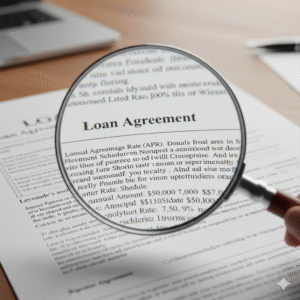
The Offer Review: When you receive the contract (PDF), read the Truth in Lending disclosure box. This shows the APR and total cost.
-
The Verification: If they call you, verify they are who they say they are. If you are unsure, hang up and call the number listed on their official website.
8. What to Do If You Suspect You’ve Been Scammed

If you realize too late that you have given your info to a fraudulent site, act immediately. Speed is your best defense.
-
Freeze Your Credit: Contact the major credit bureaus (Equifax, Experian, TransUnion) and place a “Freeze” on your report. This stops the scammers from taking out new loans in your name.
-
Contact Your Bank: If you gave them bank account details, alert your bank to watch for unauthorized withdrawals. You may need to close the account and open a new one.
-
Report It: File a report with your local police and the relevant cyber-crime authority (e.g., the FTC in the US or Action Fraud in the UK).
-
Change Passwords: If you used a password on the scam site that you use elsewhere (like for your email), change it everywhere immediately.
9. Convenience Without Compromise
Is online lending safe? Yes. In fact, it is often safer, faster, and cheaper than the traditional alternative—provided you stay vigilant.
The digital financial world is not the Wild West anymore; it is a regulated highway. But just like any highway, there are rules of the road. Don’t hitchhike with strangers (unsolicited emails), don’t pay tolls to people standing on the side of the road (upfront fees), and always check your map (verify the URL).
By arming yourself with skepticism and verifying the “Green Flags,” you can leverage the power of online lending to build your business, buy your home, or consolidate debt without risking your financial security.