What is the NYSE?
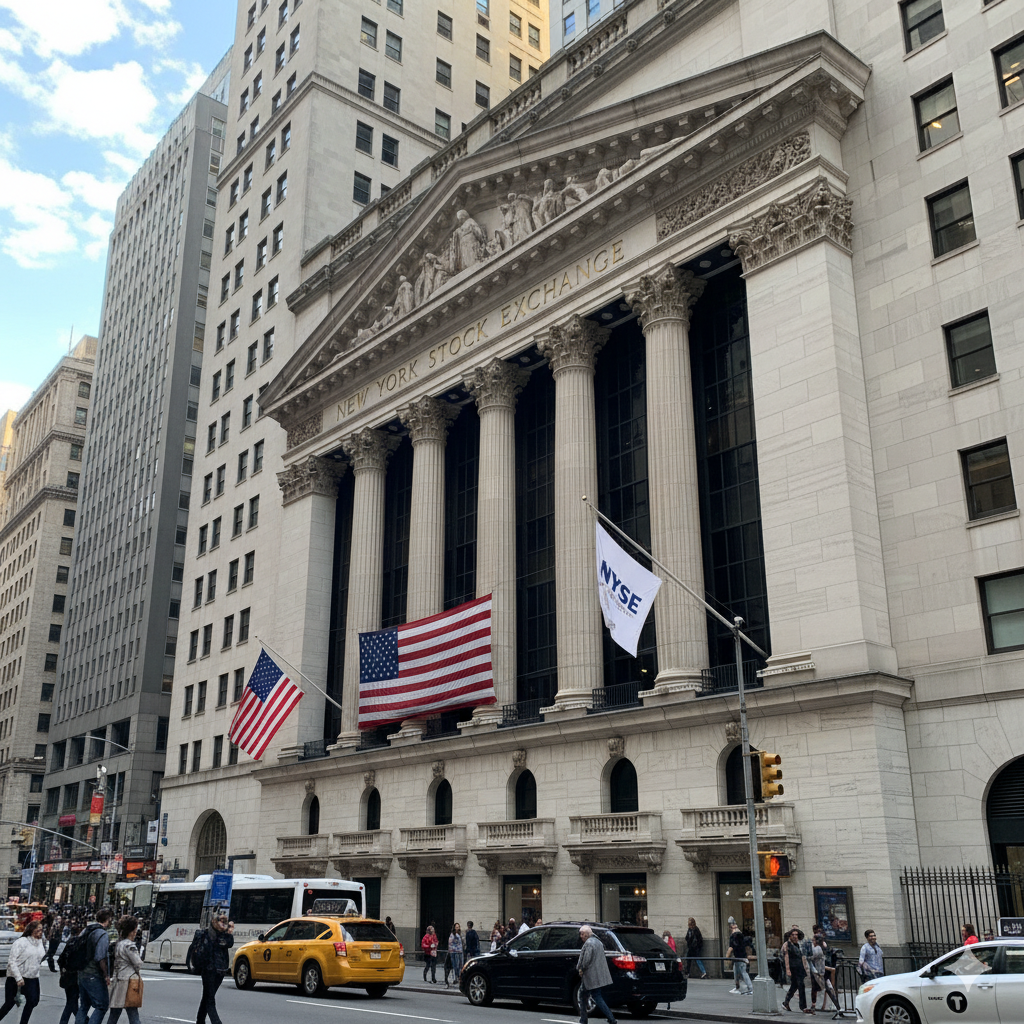
When you picture “Wall Street,” what comes to mind? Is it the frantic energy of traders shouting, the iconic image of a massive building draped in an American flag, or the sound of a bell ringing to open and close the market?
All these enduring images point to one central institution: the New York Stock Exchange (NYSE).
For over 200 years, the NYSE has been the beating heart of American capitalism. It’s the market where the shares of the most iconic “blue-chip” companies in the world—brands you use every single day, like Coca-Cola, Walmart, Johnson & Johnson, and Disney—are bought and sold.
But in an age of digital trading and smartphone apps, what is the NYSE, really? Is it just an old, historic building, or is it still a vital part of your investment world?
This comprehensive guide will demystify the “Big Board.” We’ll explore its rich history, how it fundamentally differs from its tech-savvy rival the NASDAQ, and what actually happens on that famous trading floor.
What Is the New York Stock Exchange (NYSE)?

At its simplest, the New York Stock Exchange (NYSE) is a highly regulated stock exchange—a marketplace—located at 11 Wall Street in Lower Manhattan, New York City. Its primary function is to provide a central location where buyers and sellers can come together to trade shares (or “stock”) in publicly listed companies.
It’s often called the “Big Board” because of its sheer size and the prestige of the companies listed on it. By total market capitalization (the combined value of all the companies listed on it), the NYSE is the largest stock exchange in the world.
While it is a symbol of American finance, the NYSE is no longer an independent entity. Since 2013, it has been owned by Intercontinental Exchange (ICE), a global powerhouse in financial markets and data services. This ownership has modernized the NYSE significantly, but its core identity remains.
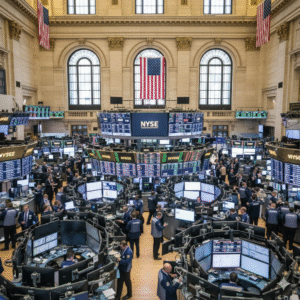
Unlike a digital-only exchange, the NYSE is a “hybrid market.” It combines state-of-the-art electronic trading with a human-centric, physical trading floor. This unique blend is what sets it apart.
A Walk Through History: The NYSE’s Origin Under a Buttonwood Tree
To understand the NYSE’s “blue-chip” reputation, you have to look at its roots. The exchange’s history is a story of America’s economic growth.
The NYSE traces its origins back to May 17, 1792. On that day, 24 stockbrokers gathered under a buttonwood tree outside 68 Wall Street to sign the Buttonwood Agreement. This simple, two-sentence document wasn’t just a gentleman’s agreement; it was a revolutionary business plan.
The brokers agreed to two main principles:
- They would only trade with each other.
- They would charge a standardized commission rate (0.25%) on all trades.
This pact effectively created an exclusive club that brought order and trust to the chaotic securities trading of the day. By only dealing with each other, they established a network of trusted partners, and by setting a fixed commission, they eliminated the risk of being undercut.
This small group first rented a room in a coffee house to conduct their business, formally organizing as the New York Stock & Exchange Board in 1817. As the United States grew, so did the exchange. It financed massive projects like the Erie Canal and the first railroads. After the Civil War, it became the driving force behind America’s industrial revolution, funding the steel, oil, and manufacturing giants that built the modern world.
The iconic building at 11 Wall Street, with its massive Corinthian columns, opened in 1903. This history is why the NYSE is synonymous with “old money,” industrial power, and established, stable companies. It grew up with America’s industrial giants, and that legacy defines its character to this day.
How Trading Actually Works on the NYSE: The “Auction Market” Explained

This is the most critical concept to understand about the NYSE. It is fundamentally different from any other market.
The NASDAQ is a “dealer’s market,” where prices are set by competing dealers (or “market makers”) on a computer network. You can think of it like a giant car dealership with multiple dealers all offering a price for the same car.
The NYSE, by contrast, is an “auction market.” Think of it like a high-end art auction at Sotheby’s. There is one central point of sale, and the price is determined by matching the highest bid (buy price) with the lowest offer (sell price).
This process is managed by a single, crucial human: the Designated Market Maker (DMM).
The Role of the Designated Market Maker (DMM)
Every single company listed on the NYSE is assigned to a DMM (formerly known as a “specialist”). The DMM is a highly specialized trader who works on the exchange floor at a specific trading post. They have two primary jobs:
- To Maintain a “Fair and Orderly” Market: The DMM acts as the auctioneer. They see all the incoming “bid” and “ask” orders for their assigned stock. Their job is to match these orders. If a flood of “sell” orders comes in with few buyers, the price will drop. If a flood of “buy” orders comes in, the price will rise. The DMM facilitates this “price discovery” process.
- To Provide Liquidity (When Necessary): What happens if there’s a temporary panic and everyone wants to sell, but there are no buyers? In a purely electronic market, the price could plummet to zero in seconds. The DMM has a legal obligation to step in and use their own capital to buy shares, acting as a “buyer of last resort” to cushion the fall and stabilize the market. They do the same on the buy side, selling from their own inventory if demand suddenly spikes.
This human element is the NYSE’s signature feature. It’s designed to reduce volatility and provide a human “circuit breaker” during times of extreme market stress.
The “Hybrid Market”: People and Computers Working Together
Now, it’s important to know that the NYSE floor isn’t like it was in the 1980s. You won’t see traders frantically waving paper tickets for every single trade.
Today, the NYSE is a hybrid market. The vast majority (well over 90%) of simple, everyday trades are executed electronically in fractions of a second by the exchange’s supercomputers, just like on the NASDAQ.
The DMMs and floor brokers are still there, but they handle the big stuff:
- The Opening and Closing Auctions: The DMM is responsible for setting the official “opening price” of a stock each day, a complex process that balances all the orders that came in overnight. They do the same for the “closing price,” which is critical for index funds.
- Large Institutional Trades: When a massive pension fund wants to sell $50 million worth of a stock, they don’t just dump it on the market—that would cause a crash. They use a floor broker who works with the DMM to “work” the order, selling it off in pieces to minimize market impact.
- High-Volatility Events: When major news breaks (like a bad earnings report or a market crash), the DMM steps in to pause trading, manage the influx of orders, and ensure the price discovery is orderly, not panicked.
NYSE vs. NASDAQ: Understanding the Key Differences
For investors, the most common question is: “What’s the difference between the NYSE and the NASDAQ?” While they are both major U.S. stock exchanges, they are built on different philosophies and attract different kinds of companies.
| Feature | New York Stock Exchange (NYSE) | NASDAQ |
| Founded | 1792 | 1971 |
| Trading Model | Auction Market (Hybrid) | Dealer’s Market (All-Electronic) |
| Key Role | Designated Market Maker (DMM) | Multiple Market Makers (Dealers) |
| Physical Location | Yes. Iconic trading floor on Wall St. | No. It’s a decentralized computer network. |
| Company Vibe | “Blue-Chip,” established, industrial, stable | “Tech-heavy,” growth-oriented, innovative |
| Famous Companies | Walmart, Coca-Cola, Disney, Johnson & Johnson, JPMorgan Chase, ExxonMobil | Apple, Microsoft, Amazon, Google, Tesla, NVIDIA |
| Listing Style | Seen as the “gold standard” with very strict profitability & revenue requirements. | Historically more welcoming to younger tech companies (even if not yet profitable). |
| Nickname | “The Big Board” | “The Tech Exchange” |
This rivalry is a defining feature of the U.S. market. The NYSE represents stability and established industry, while the NASDAQ represents innovation and high growth.
What Are “Blue-Chip” Stocks? The Heart of the NYSE
You can’t talk about the NYSE without talking about “blue-chip” stocks. The term is a core part of its identity.
A blue-chip stock is a share in a large, well-known, and financially sound company that has a long, proven history of reliable operation and, often, paying dividends to its shareholders.
These are companies that are leaders in their industries and are considered “household names.” Think of:
- Procter & Gamble (PG): Selling household goods for over 180 years.
- Johnson & Johnson (JNJ): A healthcare giant for over 130 years.
- Coca-Cola (KO): A global brand for over 130 years.
- JPMorgan Chase (JPM): A bank with roots stretching back to 1799.
The term “blue-chip” comes from poker, where the blue chips are traditionally the ones with the highest value. These stocks are seen as “safer” investments because they have survived multiple wars, recessions, and technological shifts, all while remaining profitable.
The NYSE’s strict listing requirements naturally favor these kinds of large, profitable, and established companies, which is why the “Big Board” and “blue-chip” are so closely linked.
How Does a Company Get Listed on the “Big Board”?
Getting listed on the NYSE is like getting accepted to an Ivy League university. It’s a mark of prestige and a sign that a company has “made it.” The reason for this is the strict listing requirements, which are designed to protect investors from unproven or unstable companies.
While the exact financial figures change over time, a company must generally meet very high minimums, such as:
- Minimum Market Value: The company’s total worth must be in the hundreds of millions, if not billions, of dollars.
- Minimum Share Price: The stock must trade above a certain price (e.g., $4).
- Financial Health: This is the key. The company must prove it is profitable, with millions in pre-tax earnings over the last few years. This is a major hurdle that many young, fast-growing tech companies (which are often unprofitable) cannot clear, which is why they often list on the NASDAQ instead.
- Share Distribution: The company must already have a large number of public shareholders.
When a company first lists its shares for public sale, it’s called an Initial Public Offering (IPO). An IPO on the NYSE is a massive media event, culminating in the company’s CEO and founders ringing the opening bell.
The Iconic Bell: More Than Just a Sound
The ringing of the opening (9:30 AM ET) and closing (4:00 PM ET) bells at the NYSE is one of the most famous rituals in the financial world. But it’s not just for show; it serves a critical, practical purpose.
- It Synchronizes the Market: The bell is a loud, clear signal to traders all over the world that the “official” trading session for the day has begun and ended. Any trades that happen before the opening bell or after the closing bell are part of “pre-market” or “after-hours” trading, which have different rules.
- It’s a Symbol of Order: The 16,000-square-foot trading floor is a massive, complex place. The bell provides a definitive, unmistakable start and stop, preventing any disputes about when the market was “open.”
Over the years, the bell-ringing ceremony has also become a powerful media and branding event. Companies use their IPO day to ring the bell. CEOs will ring the bell on the anniversary of their listing or to announce major news. Celebrities, politicians, and world leaders are often invited as guests to ring the bell, bringing global media attention to the exchange.
How to Invest in NYSE-Listed Companies (For Beginners)
So, the NYSE is home to the world’s biggest companies. How can you, as an average investor, buy a piece of them? It’s much simpler than you think. You don’t need to be on the floor in New York; you just need a standard brokerage account.
Method 1: Buying Individual Stocks
This is the most direct approach. If you believe in a specific company, you can buy its shares.
- Example: You love Disney’s theme parks and movies ($DIS), you shop at Walmart every week ($WMT), or you use a Visa card every day ($V).
- How: You open a brokerage account online (with firms like Fidelity, Charles Schwab, Vanguard, or apps like Robinhood). You deposit money, search for the company’s “ticker symbol” (e.g., “KO” for Coca-Cola), and place a “buy” order.
- Pros: You are a direct part-owner of a company you know and believe in. All dividends and gains are yours.
- Cons: This is higher-risk. Your entire investment’s performance is tied to that one company.
Method 2: Buying Index Funds and ETFs (The Easiest Way)
For most people, this is the simplest and safest way to invest. Instead of trying to pick one winning stock, you buy a “basket” that holds hundreds of stocks at once.
- The Dow Jones Industrial Average ($DIA): The “Dow” is an index of 30 massive “blue-chip” stocks that are leaders in their industries. Most of them (like The Home Depot, Goldman Sachs, and Johnson & Johnson) trade on the NYSE. You can buy an ETF with the ticker symbol $DIA that holds all 30 of these stocks.
- The S&P 500 ($VOO, $SPY): This is the most famous index. It tracks 500 of the largest U.S. companies. While it includes NASDAQ stocks (like Apple), it is dominated by NYSE-listed blue-chip companies. Buying an S&P 500 ETF (like $VOO or $SPY) is the most common way to get broad exposure to the stable, established companies on the NYSE.
By buying one of these funds, you get instant diversification. You are no longer betting on one company, but on the success of the American economy as a whole.
A Symbol of Stability in a Digital Age
The New York Stock Exchange is far more than just a beautiful building on Wall Street. It is a living piece of American history and a critical component of the global financial system.
While trading is now dominated by computers, the NYSE’s hybrid “auction market” model and its human DMMs still provide a unique layer of stability and human judgment in a world of high-speed algorithms. Its “Big Board” remains the global “gold standard” for listing, a symbol that a company has achieved a rare level of success and stability.
For you as an investor, the companies on the NYSE represent the foundation of the U.S. economy—the “blue-chips” that have built fortunes, paid dividends, and powered America for centuries.