Why does saving money seem difficult?

We have all been there. You look at your bank account at the end of the month and ask the same frustrating question: “Where did it all go?”
You work hard. You earn a decent living. You know the basic math—spend less than you earn. It sounds incredibly simple on paper. Yet, for millions of people around the world, the act of saving money feels like trying to hold water in a sieve. No matter how much pours in, it all seems to leak out.
If you feel this way, you are not alone, and more importantly, it is not entirely your fault.
For decades, the financial industry has treated money management as a logical problem. They hand you a calculator and a spreadsheet and tell you to “be disciplined.” But this approach ignores a fundamental truth: Money is not about math; it is about biology, psychology, and environment.
We are living in an economic environment designed to extract money from us, using brains that evolved to consume resources immediately for survival. The deck is stacked against the saver.
In this deep dive, we will move beyond the basic advice of “skip the latte.” We will explore the neuroscience of spending, the invisible economic forces at play, and the psychological traps that sabotage your financial future. By understanding why saving feels so hard, you can finally stop fighting your instincts and start building the wealth you deserve.
The Evolutionary Mismatch: Your Brain on Dopamine

To understand why you can’t save, you have to look at the hardware inside your skull. Our brains evolved hundreds of thousands of years ago in an environment of scarcity. In the Paleolithic era, if you found food, the logical survival strategy was to eat it now. Storing it for 30 years wasn’t an option.
Hyperbolic Discounting and Present Bias
In modern behavioral economics, this evolutionary trait is known as Hyperbolic Discounting or Present Bias.
Essentially, your brain values immediate rewards significantly more than future rewards.
-
The Choice: Would you prefer $100 today or $110 in a month?
-
The Brain’s Reaction: Most people take the $100 today.
When you try to save for retirement, you are asking your brain to sacrifice a tangible pleasure today (a dinner out, a new phone, a vacation) for a theoretical benefit to a stranger: “Future You.”
Neurologically, when you think about your future self, your brain lights up in the same regions as when you think about a stranger. You don’t feel an emotional connection to the version of you that will exist in 20 years. Therefore, spending money now feels like self-care, while saving feels like giving money away.
The Dopamine Loop
Furthermore, shopping triggers the release of dopamine—the “feel-good” neurotransmitter. Retailers and app designers know this. The “Buy Now” button, the unboxing experience, and the notification of a sale are all engineered to give you a chemical hit. Saving money, by contrast, provides no immediate dopamine rush. It is boring. In a battle between a chemical high and a spreadsheet, the high usually wins.
Parkinson’s Law: Why More Income Doesn’t Solve the Problem
A common myth is, “If I just earned more money, saving would be easy.”
History and data suggest otherwise. We often see high-income earners—doctors, lawyers, tech executives—living paycheck to paycheck. Why does this happen? The answer lies in Parkinson’s Law.
Originally, C. Northcote Parkinson stated that “work expands to fill the time available for its completion.” In finance, the corollary is: “Expenses expand to rise to meet income.”
The Mechanics of Lifestyle Creep
When you get a raise, you don’t usually put that extra money straight into savings. Instead, you rationalize upgrades.
-
The reliable sedan becomes a leased luxury SUV.
-
The home-cooked meal becomes a reservation at a steakhouse.
-
The apartment becomes a house with a mortgage.
This is called Lifestyle Creep. It is insidious because it happens slowly. You acclimate to the new level of luxury immediately (a phenomenon called Hedonic Adaptation). Once you get used to the heated seats and the expensive wine, going back feels like deprivation.
This is why saving feels hard even when you are earning double what you earned ten years ago. Your “needs” have grown as fast as your paycheck.
The Attention Economy: Fighting an Unfair Battle
It has never been harder to save money than it is right now. Not necessarily because of wages, but because of access.
Fifty years ago, if you wanted to spend money, you had to physically leave your house, go to a store, carry cash, and make a purchase. There was “friction” in the spending process. That friction gave you time to think.
The Frictionless Economy
Today, the friction is gone. Companies like Amazon, Uber, and Apple have spent billions of dollars removing every barrier between your impulse and your wallet.
-
One-click ordering.
-
FaceID payments.
-
Saved credit card details.
-
“Buy Now, Pay Later” schemes.
You can spend $500 while lying in bed in the dark, half-asleep.
Targeted Algorithmic Pressure
Furthermore, you are being hunted. Marketing algorithms analyze your search history, your location, and even your conversations to show you ads for the exact thing you want, at the exact moment you are most vulnerable to buying it.
You are not just fighting against your own will; you are fighting against supercomputers designed to dismantle your self-control. When you realize this is an asymmetric war, you understand why reliance on “willpower” is a failing strategy.
The Invisible Thief: Inflation and the Cost of Living
We must acknowledge the systemic reality. It isn’t all in your head. Saving feels harder because, mathematically, life has become more expensive relative to wages in many parts of the world.
The Purchasing Power Erosion
Inflation is the silent tax on your money. If the cost of housing, healthcare, and education rises faster than your salary, your “disposable income” (the money left over to save) shrinks.
For previous generations, the ratio of home prices to income was much lower. Today, a significant portion of a young earner’s paycheck goes strictly to rent or mortgage payments. When 40% or 50% of your income goes to housing alone, the margin for error is razor-thin.
This creates a psychological state of Scarcity Mindset. When you feel squeezed, your brain tunnels its focus on immediate survival (paying the bills this week) rather than long-term thriving (investing for next decade). It is cognitively difficult to plan for the future when the present feels so expensive.
Decision Fatigue: The Willpower Battery
Have you ever noticed that you are more likely to break your diet or your budget in the evening? This is due to Decision Fatigue.
Your brain has a limited supply of decision-making energy each day. Every choice you make drains this battery:
-
What to wear?
-
Which email to answer first?
-
What to eat for lunch?
By the time you get home, your “willpower battery” is empty. This is when you are most susceptible to impulse spending. You order takeout because cooking requires decisions. You buy the gadget on Instagram because you lack the mental energy to resist.
Saving money requires active, conscious decisions. Spending money is the path of least resistance. When you are exhausted, the path of least resistance always wins.
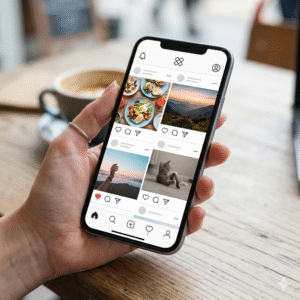
The Social Trap: FOMO and the “Instagram Effect”
We are social creatures. We look to our peers to determine what is “normal.” In the past, “keeping up with the Joneses” meant trying to match your next-door neighbor’s car.
Today, your “neighbors” are billionaires, celebrities, and influencers on social media.
The Curated Reality
Social media creates a distorted view of reality. You see the highlight reels of everyone else’s life—the vacations in Bali, the new cars, the luxury dinners. You do not see their credit card bills or their anxieties.
This triggers FOMO (Fear Of Missing Out). Spending money becomes a way to signal belonging.
-
“Everyone is going to that concert, I have to go too.”
-
“Everyone has the new phone, mine looks old.”
When saving money means saying “no” to social events or trends, it feels like social suicide. The pain of isolation is a powerful biological driver that overrides financial logic.
The Solution: How to Outsmart Your Own Brain

Now that we understand why it is difficult, how do we fix it? We cannot change our biology, and we cannot stop the economy. But we can build systems that make saving the default option.
1. Automate Everything (Remove the Human)
If you have to decide to save money every month, you will fail. The solution is to remove the decision entirely.
-
Set up an automatic transfer from your checking account to your savings account to occur on payday.
-
Treat savings like a bill. The money should leave your account before you even see it.
-
Why it works: It bypasses Decision Fatigue and Present Bias. You learn to live on what is left over.
2. Use the “24-Hour Rule” to Restore Logic
To fight the frictionless economy, re-introduce friction.
-
Never buy anything non-essential immediately.
-
Force yourself to wait 24 hours (or 72 hours for larger purchases).
-
Leave the item in the online cart.
-
Why it works: The dopamine hit of the “want” fades quickly. After a day, your prefrontal cortex (logic brain) comes back online, and you often realize you don’t actually need the item.
3. Change Your Environment
If you are on a diet, you don’t keep cookies on the counter. If you are on a budget, you shouldn’t follow luxury influencers.
-
Unsubscribe from brand email lists (marketing triggers).
-
Unfollow accounts that make you feel inadequate or trigger FOMO.
-
Delete shopping apps from your phone.
-
Why it works: It reduces the visual cues that trigger the desire to spend.
4. Reframe Saving as “Buying Freedom”
The language we use matters. “Saving” sounds like deprivation. It sounds like saying “no” to fun.
Try reframing it. You are not “saving money”; you are “buying time.”
-
$100 saved isn’t just a number; it might be a day you don’t have to work in the future.
-
An emergency fund isn’t a pile of cash; it is “sleep insurance.”
When you attach a positive emotional value to saving (Freedom, Safety, Autonomy), it begins to compete with the dopamine hit of spending.
5. The 50/30/20 Framework
Don’t overcomplicate it. Use a simple framework to give your brain boundaries.
-
50% Needs: Rent, groceries, utilities.
-
30% Wants: Dining out, hobbies, Netflix.
-
20% Savings: Investments, debt repayment.
This allows for guilt-free spending. As long as you hit your 20%, you can spend the 30% on whatever you want without feeling bad.
The Path of Least Resistance

Saving money feels difficult because it is difficult. It requires swimming upstream against your own biology and a culture obsessed with consumption.
However, recognizing the difficulty is the first step to overcoming it. Stop beating yourself up for lacking “willpower.” Willpower is a finite resource, and it will fail you. Instead, focus on building systems.
By automating your finances, creating friction for spending, and understanding your psychological triggers, you can turn the tide. You can trick your primitive brain into building a wealthy future.
Start small. Set up one automatic transfer today. Delete one shopping app. The goal isn’t to be perfect; the goal is to be just a little bit smarter than your instincts every single day.