7 stock market terms you need to know

The stock market can often feel like a private club with its own secret language. For a beginner, listening to a financial news broadcast or scrolling through an investment forum can feel like trying to translate ancient Greek. Terms like “bearish divergence,” “market cap,” and “dividend yield” fly around with little explanation, leaving the uninitiated feeling overwhelmed and out of the loop.
However, the barrier to entry for the stock market has been completely dismantled. In 2026, fractional shares, zero-commission trades, and AI-driven insights have made it possible for anyone with a smartphone to become an owner of the world’s most successful companies. But while the tools are easy to use, the concepts remain the foundation of success.
To build wealth, you don’t need to be a math genius, but you do need to understand the vocabulary of the game. In this exhaustive guide, we will deep-dive into the seven most critical stock market terms you need to know. We will explain not just what they mean, but how they impact your money and your strategy for the long haul.
1. Bull vs. Bear Markets: Navigating Market Sentiment and Cycles

The most common metaphors in finance are the “Bull” and the “Bear.” These aren’t just mascots; they describe the overall direction and psychological state of the market. Understanding which animal is currently in charge is the first step toward managing your expectations and your emotions.
What is a Bull Market?
A Bull Market occurs when stock prices are rising or are expected to rise. It is defined by widespread optimism, high investor confidence, and a general belief that strong results will continue.
-
The Metaphor: Think of how a bull attacks—it thrusts its horns upward.
-
The Technicality: While there is no “official” start date, a bull market is generally recognized when prices rise 20% from a recent low.
What is a Bear Market?
A Bear Market is the opposite. It is a period where stock prices drop by 20% or more from recent highs.
-
The Metaphor: Think of how a bear attacks—it swipes its paws downward.
-
The Psychology: Bear markets are fueled by pessimism and fear. Investors start selling their stocks to prevent further losses, which often creates a self-fulfilling prophecy of falling prices.
Why These Cycles Matter in 2026
In 2026, the speed of information has increased the frequency of “mini-cycles.” However, the golden rule remains: Bull markets historically last longer and gain more than bear markets lose. For a long-term investor, a bull market is a time to watch your wealth grow, while a bear market is often a “sale” where you can buy high-quality companies at a steep discount.
2. Market Capitalization: Determining the Size and Risk of a Company
When people ask, “How big is that company?” they are usually referring to Market Capitalization (or “Market Cap”). This is the total dollar value of all of a company’s outstanding shares. It is the most accurate way to measure a company’s size, rather than just looking at its share price.
The Calculation
To find a company’s market cap, you use a simple formula:
The Categories of Market Cap
Investors generally group companies into three main buckets:
-
Large-Cap ($10 Billion+): These are the “Blue Chip” companies like Apple, Amazon, or Walmart. They are generally more stable but grow more slowly.
-
Mid-Cap ($2 Billion – $10 Billion): These are companies in their prime growth phase. They offer a balance of growth potential and moderate risk.
-
Small-Cap ($300 Million – $2 Billion): These are younger, aggressive companies. They have the potential to double or triple in value, but they are much more likely to fail during an economic downturn.
Why Market Cap is a Risk Metric
Understanding market cap helps you build a balanced portfolio. If you only own small-cap stocks, your portfolio will be incredibly volatile (bumpy). If you only own large-caps, you might miss out on the explosive growth of the next big thing. In 2026, “Mega-Cap” stocks (those worth over $1 trillion) have become the anchors of most global retirement accounts.
3. P/E Ratio (Price-to-Earnings): Is the Stock a Bargain or Overpriced?
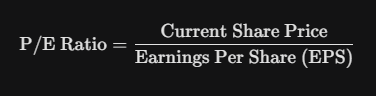
The Price-to-Earnings (P/E) Ratio is the most common tool used to determine if a stock is “expensive” or “cheap” relative to the profit it actually makes. A stock with a price of $1,000 might actually be “cheaper” than a stock worth $10 if the $1,000 company is making massive profits.
Understanding the Ratio
The P/E ratio tells you how much investors are willing to pay for every $1 of the company’s earnings.
How to Interpret the Numbers
-
High P/E: This usually means investors expect high growth in the future. They are willing to pay a premium today for the profits they expect tomorrow. However, if the company fails to meet those expectations, the stock price can crash.
-
Low P/E: This could mean the stock is a “value” bargain, or it could mean the company is in trouble and investors are staying away.
The 2026 Context: Forward P/E
In today’s fast-moving market, investors often look at the Forward P/E, which uses predicted earnings for the next year rather than past earnings. In 2026, AI-driven sectors often trade at very high P/E ratios because their potential for future disruption is so massive.
4. Dividend Yield: Getting Paid Just for Owning the Stock
For many investors, the ultimate goal isn’t just to see a number go up on a screen; it’s to create passive income. This is where Dividends come in. A dividend is a portion of a company’s profit that is paid out to shareholders, usually every three months.
What is the Dividend Yield?
The Dividend Yield is the dividend expressed as a percentage of the current stock price.

Why It Matters for Your Portfolio
If a stock costs $100 and pays $5 in dividends per year, the yield is 5%. This is money that hits your account regardless of whether the stock price goes up or down.
-
Dividend Aristocrats: These are companies that have increased their dividend every year for at least 25 consecutive years.
-
Yield Traps: Be careful of companies with extremely high yields (e.g., 15% or 20%). This often means the stock price has crashed and the company may soon stop paying the dividend entirely.
Reinvesting for Compounding
The “secret” to wealth is turning on a DRIP (Dividend Reinvestment Plan). This automatically uses your dividend cash to buy more shares of the stock, which then pay more dividends, creating a massive snowball effect over time.
5. Diversification: The Only “Free Lunch” in Finance
If there is one term that every billionaire and financial advisor agrees on, it is Diversification. This is the practice of spreading your investments across different assets so that one single failure doesn’t ruin your entire financial life.
The Logic of the Basket
Imagine you put all your money into one tech company. If that company has a scandal or a product failure, you could lose 50% of your wealth overnight. But if you own 500 different companies, one company failing barely moves the needle for you.
How to Diversify in 2026
Modern diversification isn’t just about owning different stocks; it’s about owning different Asset Classes:
-
Stocks: For growth.
-
Bonds: For stability and income.
-
Real Estate: For physical asset protection.
-
Commodities (like Gold): For protection against inflation.
The Correlation Secret
True diversification means owning things that don’t move together. For example, when stocks go down, gold often goes up. This balance ensures your portfolio has “ballast” to stay steady during a storm.
6. ETFs and Index Funds: The Modern Way to Invest
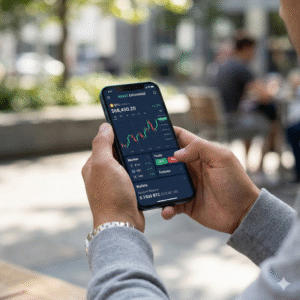
In the past, to be diversified, you had to manually buy 50 different stocks. Today, we use ETFs (Exchange-Traded Funds) and Index Funds.
What is an ETF?
An ETF is a “basket” of stocks that you can buy with a single click. When you buy one share of an S&P 500 ETF (like VOO or IVV), you are instantly buying a tiny piece of the 500 largest companies in the U.S.
Why Beginners Love Them
-
Low Cost: Most index ETFs have an “Expense Ratio” (fee) of less than 0.05%.
-
Passive Management: You aren’t paying a “genius” to pick stocks; you are just tracking the market. Historically, passive index funds outperform most professional stock pickers over the long term.
-
Liquidity: You can buy and sell them instantly during market hours.
The Core-Satellite Strategy
Many 2026 investors use a “Core-Satellite” approach: they put 80% of their money into a safe, broad-market index fund (the Core) and 20% into individual stocks or “thematic” ETFs like Robotics or Clean Energy (the Satellites).
7. Volatility and Beta: Measuring the “Bumpy Ride”
If the stock market were a smooth, straight line upward, everyone would be rich. But the market is a roller coaster. Volatility is the measure of how much and how quickly a stock’s price moves.
Understanding Beta
Beta is a specific number used to measure a stock’s volatility compared to the rest of the market (usually the S&P 500).
-
Beta = 1.0: The stock moves exactly with the market.
-
Beta > 1.0: The stock is more volatile. If the market goes up 10%, this stock might go up 15%. If the market drops 10%, this stock might drop 15%. (Example: High-growth tech stocks).
-
Beta < 1.0: The stock is less volatile. It’s like a slow, steady turtle. (Example: Utility companies or consumer staples like toothpaste manufacturers).
Why Volatility is Your Friend
Beginners often fear volatility, but experienced investors embrace it. Without volatility, there would be no opportunity to buy great companies at a discount. In 2026, the VIX (Volatility Index), also known as the “Fear Gauge,” is used by traders to see when the market is becoming overly panicky—which is often the best time to buy.
The Psychology of Investing: Moving Beyond the Terms
Knowing the terms is only half the battle. The other half is mastering your own brain. Investing is one of the few areas in life where doing less often leads to making more.
The Danger of FOMO (Fear Of Missing Out)
In 2026, social media can make it feel like everyone is getting rich on a new crypto coin or a “meme stock” except you. This leads to FOMO, causing beginners to buy at the peak of a bubble. Understanding Market Cap and P/E Ratios allows you to see through the hype and realize when a price no longer matches reality.
Loss Aversion: Why Red Hurts More Than Green Feels Good
Psychologically, the pain of losing $1,000 is twice as powerful as the joy of gaining $1,000. This is why many people sell their stocks during a Bear Market—they just want the pain to stop. But by selling, they turn a “paper loss” into a real loss. Successful investors train themselves to see red days as a temporary weather event, not a permanent catastrophe.
Creating Your 2026 Investment Strategy: Step-by-Step

Now that you have the vocabulary, how do you put it into action?
1. The Emergency Fund First
Before you buy a single share, you must have 3 to 6 months of living expenses in a high-yield savings account. This ensures you never have to sell your stocks to pay for a car repair or a medical bill.
2. Choose Your “Bucket”
Decide which account you will use. In the U.S., a Roth IRA is a favorite because your money grows tax-free. If you are outside the U.S., look for your country’s equivalent of a tax-advantaged retirement account.
3. Start with an Index Fund
Don’t try to find the “next Amazon” yet. Put your first $1,000 into a total market ETF. This gives you immediate exposure to Bull Markets while providing Diversification to protect you.
4. Automate and Ignore
Set up an automatic transfer of $50, $100, or $500 every month. This is called Dollar-Cost Averaging. It ensures you buy more when prices are low and less when prices are high. Once it’s set up, stop checking your account every day.
Frequently Asked Questions (FAQs) for New Investors
Is the stock market a gamble?
If you are buying individual stocks based on a “tip” without looking at their P/E Ratio or Market Cap, yes, it’s gambling. But if you are buying a diversified index fund and holding it for 10+ years, it is a mathematically proven way to build wealth.
How much money do I need to start?
In 2026, you can start with $1. Most major brokerages allow for fractional shares, meaning you can own 0.0001% of a share of a big company.
Can I lose all my money?
If you invest in a single, small-cap company that goes bankrupt, yes. But if you invest in a broad-market ETF, the only way you lose all your money is if every major company in the world goes to zero simultaneously—at which point, the stock market would be the least of your problems.
Should I wait for the “right time” to buy?
No. Time in the market is better than timing the market. Even if you buy right before a crash, if you hold for 20 years, you will likely come out ahead.
The Journey of a Thousand Miles
Building wealth in the stock market is a marathon, not a sprint. The terms we’ve discussed today—Bull and Bear Markets, Market Cap, P/E Ratio, Dividend Yield, Diversification, ETFs, and Volatility—are the tools you will use to build your financial house.
The most important thing you can do in 2026 is to move from being a consumer to being an owner. Every time you buy a product from a big company, ask yourself: “Should I also own a piece of this business?”
Start small, stay consistent, and let time and compounding do the hard work for you. The market doesn’t reward the smartest person; it rewards the most patient.