Learn how to refinance a personal loan
Taking out a personal loan can be a smart financial move. It can help you consolidate high-interest debt, finance a home renovation, or cover a major, unexpected expense.
But what happens when the loan you took out a few years ago no longer feels like such a great deal? Maybe your credit score has skyrocketed since then. Maybe interest rates across the country have dropped. Or maybe your monthly payment just feels too tight.
If you’re stuck in a loan that’s “just okay,” you’re not stuck at all. The answer could be refinancing.
Refinancing is a powerful financial tool that can save you thousands of dollars, lower your monthly payments, and get you out of debt faster. But it’s also a formal application process, and if you do it wrong, it can cost you.
This is your complete, step-by-step guide to what refinancing is, when you should do it, and how to do it the right way.
What Does It Really Mean to Refinance a Personal Loan?

In the simplest terms, refinancing a personal loan means replacing your old loan with a new one.
It’s just like trading in a car. You had an “old” loan with a specific interest rate, payment, and term. You are now “trading it in” for a “new” loan that has a new interest rate, a new payment, and a new term.
Here’s the mechanism:
- You shop for and get approved for a new personal loan.
- The new lender gives you the money.
- You use that money to pay off the entire balance of your old loan in one lump sum.
- Your old loan account is closed.
- You now only have the new loan, and you begin making monthly payments to your new lender.
The entire goal of this process is to get a new loan that is better than your old one. But “better” can mean a few different things.
The 3 Main Reasons You Should Consider Refinancing
People refinance for three primary reasons. The right reason for you depends entirely on your financial goals.
1. To Get a Lower Interest Rate (APR)
This is the single best and most common reason to refinance. Your loan’s APR (Annual Percentage Rate) is the “price” you pay for borrowing money. The lower the APR, the less money you pay in interest.
You might qualify for a lower rate if:
- Your credit score has significantly improved. Did you get your first loan with a “fair” 650 FICO score? If you’ve spent the last two years paying every bill on time, your score might now be an “excellent” 760. This new score unlocks the best rates.
- Overall interest rates have dropped. If the Federal Reserve has lowered interest rates, the rates on all new loans will be lower than they were a few years ago.
The Benefit: A lower APR means more of your monthly payment goes toward the principal (the money you actually borrowed) and less goes to interest (the lender’s profit). This saves you a lot of money.
2. To Lower Your Monthly Payment
This goal is all about short-term cash flow. If your monthly budget is too tight, you can refinance your loan to get a longer term.
- Example: You have 3 years left on a $10,000 loan. Your payment is $350/month.
- Your Refinance: You get a new 5-year loan for $10,000. Your new payment might drop to $220/month.
This frees up $130 in your monthly budget. But you must understand the trade-off.
The Critical Warning: While this feels good right now, you will almost always pay more in total interest over the life of the loan. You’ve stretched the same debt out over a longer period. This is a “cash flow relief” move, not a “save money” move.
3. To Pay Off Your Loan Faster
This is the opposite strategy and is for people who are in a strong financial position. You can refinance from a long-term loan to a shorter term.
- Example: You have 5 years left on a 4% APR loan.
- Your Refinance: You get a new 3-year loan. The lender might even give you a lower APR (e.g., 3.5%) for choosing a shorter term.
Your monthly payment will be higher, but you will be debt-free years sooner and will save a significant amount in total interest.
Your Pre-Refinance Checklist: 4 Steps Before You Apply
Don’t just start applying for new loans. Preparation is key. You must do these four things first.
1. Check for a Prepayment Penalty on Your Current Loan
This is the #1 deal-breaker. A prepayment penalty is a fee your current lender charges you for the “privilege” of paying off your loan early.
Why? Because they were counting on all that future interest from you.
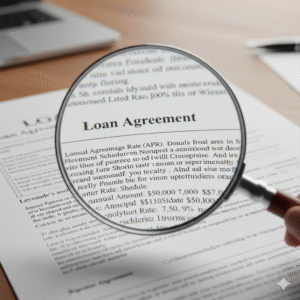
- How to check: Read your original loan agreement (the fine print) or just call your lender and ask, “Is there a prepayment penalty on my loan?”
- The Math: If your new loan will save you $800 in interest, but your old loan has a $500 prepayment penalty, you’re only saving $300. You have to decide if the hassle is worth it. If the penalty is higher than your savings, do not refinance.
2. Know Your Credit Score (This is Your Bargaining Power)
Your credit score is your entire report card. It’s the key that unlocks low rates. You must know your number before you shop.
- What you need: You’ll need “good” to “excellent” credit to get a rate that’s worth refinancing for. This generally means a FICO score of 700 or higher. The best rates (760+) will give you the most savings.
- How to check: You can get your score for free from your credit card’s mobile app, your bank’s website, or a free service like Credit Karma or Experian.
3. Calculate Your Debt-to-Income (DTI) Ratio
Lenders don’t just look at your score; they look at your income. Your DTI ratio is the percentage of your gross monthly income that goes toward all your monthly debt payments (rent/mortgage, auto loans, student loans, etc.).
- Simple Formula: (Total Monthly Debt Payments) / (Total Gross Monthly Income) = DTI
- Why it matters: Lenders want to see a DTI below 40% (and ideally below 35%). It proves you have enough “room” in your budget to comfortably afford the new loan payment.
4. Gather Your Documents
Have these ready to make the application process smooth:
- Proof of Income: Recent pay stubs or W-2s.
- Proof of Identity: Driver’s license or Social Security number.
- Current Loan Statement: You’ll need the exact payoff amount and your account number.
How to Refinance Your Personal Loan in 5 Simple Steps

You’ve done your homework. Now it’s time to go shopping.
Step 1: Shop Around for the Best Offers
Do not just walk into your local bank and take their first offer. This is a market, and you need to find the best deal.
- Credit Unions: They are non-profits and are famous for offering the lowest interest rates and fees. This should be your first stop.
- Online Lenders (Fintech): Companies like SoFi, LightStream, and Marcus are very competitive. They are fast, and their online tools make it easy to see your potential rate.
- Traditional Banks: If you have a long-term checking account with a major bank (Chase, Bank of America), they may offer you a relationship discount.
Step 2: Use “Pre-Qualification” to Compare Rates (The Safe Way)
This is a pro-tip. You do not have to formally apply for a loan just to see what rate you’ll get.
- Pre-Qualification: This uses a “soft” credit pull. You enter your info, and the lender gives you a very accurate rate estimate. A soft pull does not affect your credit score.
- Formal Application: This uses a “hard” credit pull (or “hard inquiry”). This does temporarily ding your score by 5-10 points.
You should pre-qualify with 3-5 different lenders (at least one credit union, one online lender, and your bank) to see who has the best real offer for you.
Step 3: Compare the Total Cost (APR, Fees, and Term)
You have your offers. Now you must compare them correctly.
- Look at the APR, not the “Interest Rate.” The APR includes the interest plus any mandatory fees. It’s the true cost of the loan.
- Watch for Origination Fees: This is a hidden fee on the new loan. It’s a “processing” fee, often 1% to 5% of the loan amount, that they take out before you even get the money. A “no-fee” loan with a 7% APR is better than a “5% fee” loan with a 6% APR.
- Use a Loan Calculator: Plug in the new loan’s amount, APR, and term. Compare the total interest paid on the new loan to the remaining interest you would have paid on the old one. This is your true savings.
Step 4: Formally Apply and Submit Your Documents
You’ve found your winner. Now you officially apply. This is when they will run the “hard” credit pull and ask for your pay stubs. Since you’re pre-qualified, you should be approved quickly.
Step 5: Close the Loan (And Verify the Payoff)
Once you’re approved, you’ll sign the new loan documents. The new lender will then pay off your old loan. They will either:
- Send a check directly to your old lender.
- Deposit the money in your checking account and have you pay the old lender.
Your Final, Critical Task: Call your old lender about a week later and confirm the balance is $0. Ask them to send you a “Paid in Full” letter or a zero-balance statement. Keep this for your records. Do not cancel your auto-pay on the old loan until you have this proof.
When Should You Not Refinance a Personal Loan?

Refinancing is not a magic wand. Sometimes, it’s a terrible idea.
- If Your Credit Score Has Dropped: You won’t get a better rate.
- If Your Loan Has a High Prepayment Penalty: The fee may be higher than your savings.
- If You’re Near the End of Your Loan: Most of your interest is paid in the “front-half” of a loan (this is called amortization). If you only have a year left, you’re mostly paying principal anyway. Refinancing at this point is usually a waste of time and fees.
- If You Just Want to “Buy Time”: Be honest with yourself. If you’re refinancing a 3-year loan into a 7-year loan just to get a tiny payment, you’re signing up for 4 extra years of debt. This is a “debt trap,” not a solution.
Does Refinancing a Loan Hurt Your Credit Score?
This is the most common fear, so let’s be clear.
- Yes, there is a small, temporary dip. The “hard inquiry” from your application will knock your score down a few points for a few months.
- Yes, your “average age of accounts” will go down. By closing an old account and opening a new one, you reduce the average age of your credit history, which is a small negative.
BUT…
- Yes, it helps massively in the long run. A new, lower payment makes it easier to pay on time, every time, which is the #1 factor in your score. And if you’re lowering your total debt, your score will improve.
The Verdict: Don’t let a small, 10-point temporary dip stop you from a move that will save you thousands of dollars and improve your financial health for years to come.
What Are the Alternatives to Refinancing?
Refinancing isn’t your only option.
- A 0% APR Balance Transfer Card: If your personal loan balance is small (e.g., under $10,000), you could transfer that debt to a credit card with a 0% intro APR for 12-18 months. You’ll pay a 3-5% transfer fee, but then you’ll pay zero interest. If you can pay it off before the promo period ends, this is the cheapest option.
- A Home Equity Loan (HELOC): You can borrow against your home’s equity, which will have a much lower interest rate. WARNING: This is extremely risky. You are turning unsecured debt (the personal loan) into secured debt. If you fail to pay your HELOC, you can lose your home.
- Just Pay Extra on Your Current Loan: You don’t need a new loan to get out of debt faster. Just start making extra “principal-only” payments on your current loan. No fees, no credit hit, no application.
Is Refinancing Right for You?

Refinancing a personal loan is a brilliant financial move if you are doing it for the right reasons.
- It’s a “Yes” if you’re saving money on total interest.
- It’s a “Yes” if you’re getting out of debt faster.
- It’s a “Maybe” if you’re just extending your term for a lower payment. Be sure you understand the long-term cost.
The power is in your hands. Check your credit, check your current loan for penalties, and spend 30 minutes pre-qualifying with different lenders. That 30 minutes of “shopping” could easily save you thousands.