Is it worth investing in memecoins?
In the structured world of finance—a world of credit scores, mortgage-backed securities, insurance premiums, and 401(k)s—we are trained to look for fundamentals. We analyze cash flow, profit margins, and interest rates. We build diversified portfolios to mitigate risk.
And then, there are memecoins.
You’ve probably heard the stories. A friend of a friend turns $50 into $50,000 by buying a coin with a dog on it. A random token based on an internet joke skyrockets 1,000,000% in a week.
This is the “Wild West” of the digital asset world. It’s a chaotic, confusing, and undeniably alluring casino that operates 24/7. But as an investor who understands the rules of traditional finance, you have to ask the critical question: Is this investing?
Or is it something else entirely?
This guide will break down what memecoins really are, why they move, the extreme risks that are often hidden behind the hype, and whether they have any place at all in a serious financial portfolio.
What Exactly Is a Memecoin? (And How Is It Different from Bitcoin?)
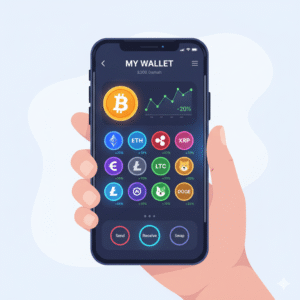
First, we must separate memecoins from “blue-chip” cryptocurrencies like Bitcoin (BTC) and Ethereum (ETH). Conflating them is the most common and costly mistake a new investor can make.
- Bitcoin (BTC): Is designed as a “store of value” and a decentralized payment system. Its value proposition is based on its provable digital scarcity (a hard cap of 21 million coins) and its incredibly secure network. You can think of it as “Digital Gold.”
- Ethereum (ETH): Is a decentralized computing platform. Its value comes from its utility. It acts as the “gas” that powers a global ecosystem of applications, including decentralized finance (DeFi), NFTs, and corporate blockchain solutions. You can think of it as a decentralized “App Store” or cloud computing service.
Memecoins are the polar opposite.
A memecoin is a cryptocurrency that is created from an internet meme, a joke, or a pop culture reference.
The Simple Analogy:
- Investing in Bitcoin is like buying gold.
- Investing in Ethereum is like buying stock in a foundational tech company like Amazon Web Services.
- Investing in a memecoin is like placing a high-stakes bet on a viral TikTok sound.
The vast majority of memecoins have no intrinsic value. They have:
- No business model.
- No revenue or cash flow.
- No assets or intellectual property.
- No technology to solve a real-world problem.
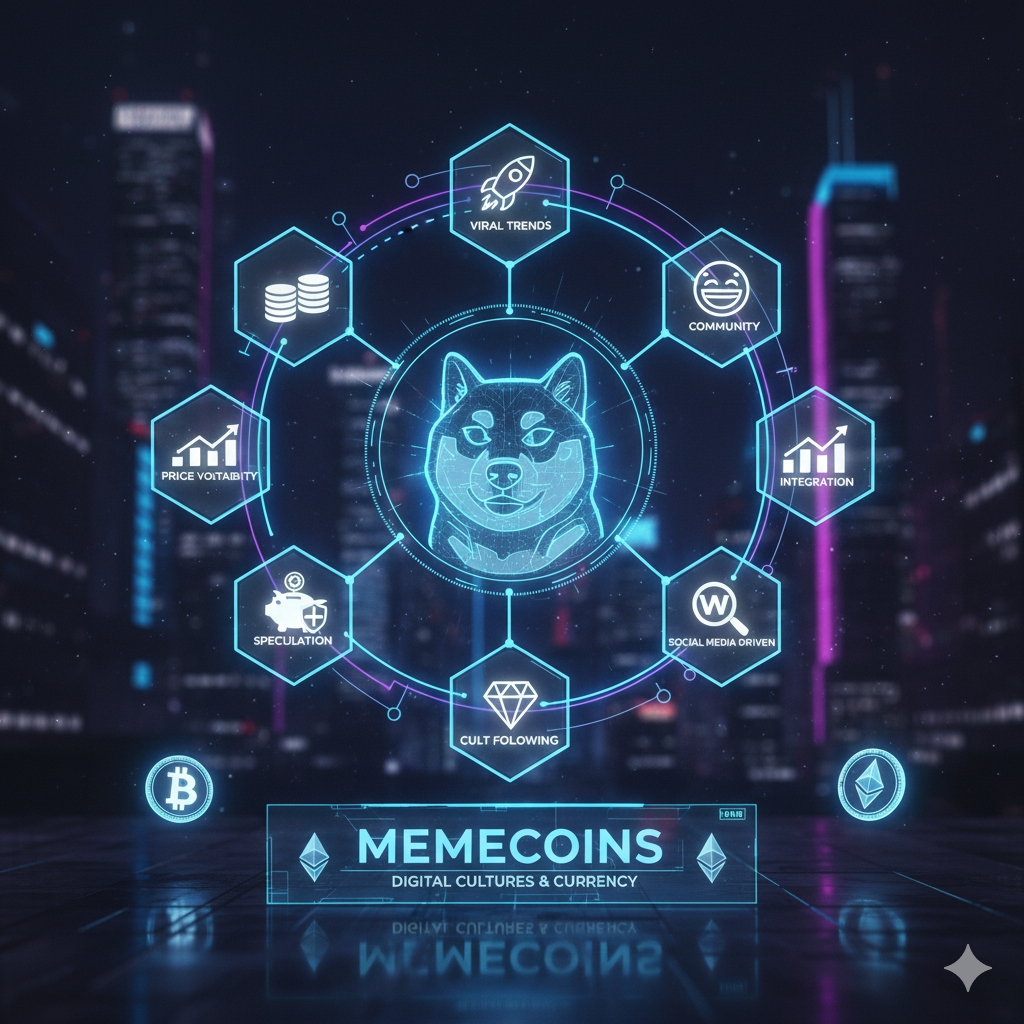
Their value is derived 100% from social media hype, community engagement, and pure speculation. They are a phenomenon of culture and marketing, not technology or finance.
The “Big Two”: Understanding Dogecoin (DOGE) and Shiba Inu (SHIB)
You can’t discuss memecoins without mentioning the two projects that started it all. It’s crucial to understand that these are the massive exceptions, not the rule. They are the 0.01% of memecoins that survived long enough to become globally recognized.
Dogecoin (DOGE): The Original Joke
Dogecoin was created in 2013 by two software engineers as a literal joke. They wanted to poke fun at the wild speculation in the crypto space by creating a “fun and friendly” currency. They took the code for Bitcoin, changed a few parameters, and slapped the “Doge” (a Shiba Inu dog) meme on it.
For years, it was a tiny, niche community. Then, in 2021, it was catapulted into the stratosphere, largely fueled by tweets from Elon Musk. Its price exploded, turning it into a top-10 cryptocurrency by market cap and making early holders millionaires.
- Key takeaway: Dogecoin’s value is purely a function of its brand awareness and its massive community. It has no real utility, though some merchants accept it as a novelty payment.
Shiba Inu (SHIB): The “Doge Killer”
Shiba Inu was created anonymously in 2020 with the explicit goal of being the “Dogecoin Killer.” It was an experiment in 100% decentralized, community-run token creation.
Its anonymous founder, “Ryoshi,” sent 50% of the total SHIB supply to Ethereum creator Vitalik Buterin’s public wallet. The (unsolicited) “gift” was a marketing masterpiece. Buterin later “burned” (destroyed) 90% of those tokens and donated the remaining 10% to charity, creating a legendary news cycle that sent the price parabolic.
- Key takeaway: Unlike Doge, the SHIB community has since tried to build an ecosystem around the meme, including a decentralized exchange (ShibaSwap) and a Layer-2 scaling solution (Shibarium). This is an attempt to build utility backward—to start with the hype and add fundamentals later.
The Psychology of Hype: Why Do Memecoins Skyrocket?
If these tokens have no fundamentals, why do they create so much wealth for a lucky few? The price is driven by a powerful set of social and psychological forces, not by balance sheets.
1. The Lottery Ticket Effect
For most people, buying a full Bitcoin (at tens of thousands of dollars) is out of reach. But you can buy 10 million Shiba Inu tokens for $100.
This is a powerful psychological trick. Owning millions of something feels more exciting and has a perceived “asymmetric upside.” It feels like buying a lottery ticket, but one where you can watch the “drawing” happen in real-time on a 24/7 chart. People are not betting on a company; they are betting on a shared dream.
2. FOMO (Fear Of Missing Out)
FOMO is the primary fuel for all speculative bubbles, and memecoins are its purest expression. You see a chart go up 500% in a day. You read a story on Reddit about someone who turned $1,000 into $1 million. You see the coin trending on Twitter (X).
This triggers a primitive, emotional response. You feel you are missing the “next big thing” and the one chance to get rich quick. This emotional buying—disconnected from all logic—is what causes the parabolic price spikes.
3. Community and Social Media
Memecoins are not “companies”; they are “communities.” Or, as they often call themselves, “armies” (e.g., the “Shib Army,” the “Doge Army”).
Their battleground is social media. The entire goal is to coordinate and create enough noise, enough memes, and enough viral content to attract new buyers. When you buy the coin, you aren’t just an “investor”; you are joining a club. This sense of belonging is a powerful motivator to “HODL” (hold on for dear life) and not sell, even when logic might suggest it.
4. Influencer and Celebrity Endorsement
A single tweet from a massive celebrity can be the difference between a coin dying and a coin “mooning” (skyrocketing). When Elon Musk talks about Doge, the price moves.
This has also created a dark side: paid “pump and dump” schemes, which we’ll cover in the risks section.
Investing vs. Gambling: The Critical Distinction for Your Portfolio

As a visitor to a finance-focused website, you understand the difference between managing risk (insurance), leveraging debt (loans), and building wealth (investing). We must be crystal clear where memecoins fall.
Investing (what you do with stocks, bonds, and real estate) is the allocation of capital with the expectation of a future profit based on fundamentals.
- You buy a stock because you believe the company will grow its earnings and cash flow.
- You buy a rental property because you’ve calculated the cash-on-cash return from rental income.
- You buy a bond for its predictable interest payments (coupons).
Gambling is the allocation of capital to an event with an uncertain outcome, hoping for a profit.
Memecoin trading is not investing; it is high-stakes, speculative gambling.
The price has no anchor in reality. It is not tied to revenue, profit, or any tangible asset. Its value is 100% determined by what the next person is willing to pay for it. This is the definition of the “Greater Fool Theory”—an economic theory stating that you can make money on an overpriced asset as long as you can find a “greater fool” to sell it to at an even higher price.
In a memecoin rally, everyone is just trying to sell to the person who buys at the absolute top.
The Dark Side: 5 Massive Risks You MUST Know Before Buying
If you treat memecoins as gambling, you must also understand the rules of the casino. In this casino, the house has many advantages, and many of the games are rigged.
1. “Rug Pulls” (The Developers Vanish)
This is the most common and devastating scam. A “rug pull” is when the anonymous developers of a new memecoin attract buyers and then, in an instant, withdraw all the real money (like Ethereum) from the project’s liquidity pool, “pulling the rug” out from under the investors.
The token’s value instantly drops to zero. There is no legal recourse. The developers are anonymous, and the money is gone forever.
2. Extreme, Unfathomable Volatility
You may be used to stock market “volatility,” where a 10% drop in a day is considered a “crash.”
A memecoin can (and often does) drop 95% in a single hour. A project that is trending on Monday can be completely dead by Tuesday. The same forces that cause the 1,000% spikes work in reverse. When the hype dies, there is no fundamental “price floor” to stop the crash. It can, and will, go to zero.
3. Pump and Dump Schemes
This is a classic financial scam, perfected for the crypto age.
- The “Pump”: A group of “whales” (large holders) or paid influencers buys a coin cheaply. They then promote it aggressively to their followers, promising “100x gains” and “the next Shiba Inu.”
- The “Dump”: As their followers (you) FOMO in, the price spikes. The original insiders then “dump” (sell) their massive bags of tokens onto the new buyers, making a huge profit.
- The Crash: The price collapses, leaving the new buyers holding worthless tokens.
4. “Honeypot” Scams
This is a particularly nasty and technical scam. The developers code the token’s “smart contract” (the underlying software) with a hidden rule: You can buy the token, but you can never sell it.
Investors buy in, see the price on the chart going up (because no one can sell), and are encouraged to buy more. When they finally try to take profits, they find the “sell” function is disabled. The developers are the only ones who can sell, and they dump all the tokens, running away with 100% of the invested capital.
5. Lack of Intrinsic Value
This is the fundamental risk that underpins all the others. Because the token has no utility or underlying business, there is no reason for it to exist once the hype fades. A stock like Apple will always have a “floor” based on its $3 trillion in assets, its intellectual property, and its hundreds of billions in annual profit.
A memecoin has a floor of zero.
How to Spot a Potential Memecoin Scam (A Quick Checklist)
While the space is filled with fraud, many scams leave behind clear red flags.
- Anonymous Team: The developers won’t show their faces or use their real names. While some legitimate projects are anonymous (like Bitcoin’s founder), in the memecoin space, it’s a giant red flag for a “rug pull.”
- Vague or Copied “Whitepaper”: The project’s “plan” is just buzzwords like “community-driven” and “revolutionary” with no substance.
- Aggressive Marketing & “Guarantees”: Any project that “guarantees” returns or promises “100x” is almost certainly a scam.
- Censorship in the Community: Go into the project’s Telegram or Discord. Ask tough questions: “Is the liquidity locked?” “Who are the developers?” “What is the token distribution?” If you are immediately banned or attacked for spreading “FUD” (Fear, Uncertainty, and Doubt), it’s a huge red flag.
- Token Distribution: Use a blockchain explorer (like Etherscan) to look at the “holders” list. If one or two wallets (belonging to the devs) hold 30-50% of the total supply, they can “dump” on the market and crash the price at any second.
- Unlocked Liquidity: Legitimate projects will use a third-party service to “lock” their liquidity pool for a set period (e.g., 1 year), proving they cannot run away with the money. Scams will have unlocked liquidity.
So, Are Memecoins Ever “Worth It”? (A Responsible Perspective)
After all this, you might wonder why anyone would buy one.
The answer is simple: the allure of life-changing gains is a powerful drug.
So, here is the only responsible way to approach memecoins within the context of a healthy financial life.
Treat it exactly like you treat a trip to Las Vegas.
It is entertainment, not investment. It is money that you must be 100% willing and able to lose. This is not your 401(k). This is not your child’s college fund. This is not your emergency savings. This is your “entertainment” budget.
If you must participate, here are the “rules of the casino”:
- Use Truly Disposable Income: We’re not talking “money I can afford to lose”; we’re talking “money I would have spent on coffee or movie tickets.” An amount so small that if it goes to zero tomorrow, you will not feel it. For 99% of people, this should be less than 1% of their total investment portfolio.
- Take Profits. Seriously. The biggest mistake is “diamond handing” (holding) a worthless token all the way back to zero. If your $100 bet turns into $1,000, sell $100 to get your initial “bet” back. Now you are playing with “house money.”
- Do Not Confuse Luck with Skill: If you win, you did not “outsmart the market.” You got lucky. Acknowledging this will prevent you from making the fatal mistake of taking your real money (from your checking account or stock portfolio) and pouring it into the next memecoin.
- Assume It’s a Scam Until Proven Otherwise: The default assumption for any new memecoin should be that it is a fraud.
Final Thoughts

For the vast majority of people building long-term wealth—focusing on their business, managing their credit, or investing in diversified index funds—memecoins are a dangerous and unnecessary distraction. The stories of overnight millionaires are loud, but the silent majority of people who lose their entire “investment” is far, far larger.
If you want to gamble, go to a casino. If you want to invest, stick to assets with fundamental value. If you want to speculate on memecoins, understand that you are not an investor; you are a gambler in a casino with no rules, no regulations, and a very good chance the dealer is planning to rob you.