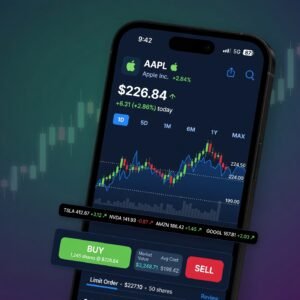
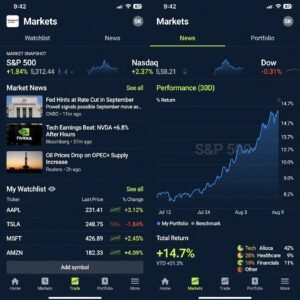
How much money do you need to get into the stock market?

The most common myth about the stock market is that it is a playground reserved exclusively for the wealthy. For decades, the image of Wall Street was defined by suits, high-rise offices, and people moving millions of dollars with a single phone call.
However, the digital revolution has completely dismantled these barriers. Today, the question isn’t whether you are “rich enough” to invest; it’s about how quickly you can put your first dollar to work. In this guide, we will break down exactly how much capital you need to enter the market, the tools that make it possible for anyone to start, and the financial foundation you should build before making your first trade.
Is the Stock Market Only for the Rich? Debunking the Millionaire Myth

If you think you need five or six figures to start an investment portfolio, you are operating on outdated information. In the past, high brokerage commissions and the requirement to buy “round lots” (groups of 100 shares) made it difficult for the average person to participate.
Today, the landscape is entirely different. Technology has “democratized” finance. With the rise of fintech apps and the shift toward zero-commission trading among major US brokerages, the “entry fee” for the stock market has essentially dropped to zero. You no longer need a fortune; you just need a strategy.
The Power of Fractional Shares: Investing with Just $1
One of the most significant advancements for small investors is the introduction of fractional shares.
In the old days, if you wanted to own a piece of a high-priced company like Amazon or Berkshire Hathaway (Class A), you would need thousands of dollars just to buy a single share. If you didn’t have that cash sitting around, you were locked out.
Fractional shares changed the game. Most modern brokerages now allow you to buy “slices” of a stock based on a dollar amount rather than a share count.
-
How it works: If a stock costs $3,000 per share, you can choose to invest $5, $10, or $50. The brokerage will assign you the corresponding percentage of that share.
-
Why it matters: This allows you to build a diversified portfolio even if you only have $100 to spend. You can own a piece of 10 different blue-chip companies simultaneously.
Understanding the True Costs: Beyond the Share Price
While many platforms offer “commission-free” trading, investing is rarely 100% free. To understand how much money you need, you must account for the secondary costs that can eat into a small account.
1. Expense Ratios (for ETFs and Mutual Funds)
If you decide to invest in an Exchange-Traded Fund (ETF) instead of individual stocks, the fund manager charges a small annual fee known as the expense ratio. For example, a fund with a 0.03% expense ratio will cost you $0.30 for every $1,000 invested. While small, these add up over decades.
2. The Bid-Ask Spread
This is the difference between the highest price a buyer is willing to pay and the lowest price a seller is willing to accept. When you buy a stock, you usually pay a tiny bit more than the “market price.” In highly liquid stocks (like Apple or Microsoft), this is negligible, but in smaller companies, it can be a hidden cost.
3. Taxes
Uncle Sam always wants his cut. If you sell a stock for a profit, you will owe Capital Gains Tax. Understanding whether you are in a “short-term” or “long-term” bracket is essential for calculating your actual net returns.
Why Your “Emergency Fund” Must Come Before Your First Trade
Before you put a single cent into the stock market, you need to look at your personal balance sheet. Investing is a long-term game, and the worst thing you can do is be forced to sell your stocks during a market crash because you have an unexpected car repair or medical bill.
The 3-6 Month Rule
Most financial experts recommend having three to six months of living expenses saved in a high-yield savings account before investing. This “buffer” ensures that your investment portfolio can grow undisturbed by the volatility of daily life.
High-Interest Debt vs. Stock Returns
If you have credit card debt with a 20% interest rate, and the stock market historically returns about 10% per year, you are mathematically losing money by investing instead of paying off the debt. Clear your high-interest hurdles first; it’s a “guaranteed” return on your money.
ETF vs. Individual Stocks: Which is Better for Small Budgets?
When you are starting with a small amount of money—say, $500 or less—you face a choice: Should you pick individual companies or buy a “basket” of stocks?
Individual Stocks (High Risk, High Research)
Buying individual stocks requires deep research. You need to understand the company’s earnings, debt, and competitive landscape. If you only have $100 and put it all in one company, and that company fails, your entire investment is gone.
ETFs (Instant Diversification)
For most beginners, an ETF that tracks the S&P 500 (the 500 largest companies in the US) is the most efficient way to start. With one purchase, you own a tiny piece of Apple, Amazon, Tesla, and 497 others. It’s the ultimate “set it and forget it” strategy for small accounts.
The Strategy of Dollar-Cost Averaging (DCA)

You don’t need a “lump sum” of $5,000 to be a successful investor. In fact, many people find more success through Dollar-Cost Averaging.
This is the practice of investing a fixed amount of money at regular intervals (e.g., $50 every two weeks) regardless of the stock price.
-
When prices are high, your $50 buys fewer shares.
-
When prices are low (during a “sale” or market dip), your $50 buys more shares.
Over time, this lowers your average cost per share and removes the emotional stress of trying to “time the market.”
Tax-Advantaged Accounts: Maximizing Every Dollar
In the United States and many other regions, where you hold your stocks is just as important as what you buy. If you are investing for the long term, you should prioritize accounts that offer tax benefits.
1. The 401(k)
If your employer offers a “match,” this is literally free money. If you contribute 3% of your salary and they match it, you have achieved a 100% return on your investment before the money even hits the market.
2. The Roth IRA
A Roth IRA allows you to contribute “after-tax” money. The beauty of this account is that your investments grow tax-free, and you won’t owe a dime in taxes when you withdraw the money in retirement. For a small investor, saving on future taxes is a massive wealth-building lever.
The Mathematics of Starting Early vs. Starting Big
Let’s look at the math of $A = P(1 + r/n)^{nt}$.
Imagine two investors:
-
Investor A starts at age 20, investing just $100 a month until age 30, then stops entirely.
-
Investor B starts at age 30 and invests $100 a month every single month until age 60.
Even though Investor B put in much more money over a longer period, Investor A will often end up with more wealth because of the power of compounding interest. The “money” you need isn’t nearly as important as the “time” you give that money to grow.
Common Pitfalls for New Investors with Small Accounts
When you start with a small amount of money, it is tempting to take high risks to “hit it big.” Avoid these common traps:
-
Penny Stocks: These are low-priced, highly volatile stocks of companies that are often failing. They are frequently used in “pump and dump” schemes.
-
Over-Trading: If you check your app 20 times a day and buy/sell constantly, you will likely lose money. Long-term wealth is built by sitting, not by clicking.
-
Emotional Investing: Don’t buy because a celebrity tweeted about it, and don’t sell because the news says the “market is crashing.” Stick to your plan.
How to Open Your First Account: A Step-by-Step Guide

If you have your emergency fund ready and $50 to spare, here is how you get started:
-
Choose a Brokerage: Look for one with $0 commissions, fractional shares, and a user-friendly app. (Common choices include Fidelity, Charles Schwab, or Vanguard).
-
Verify Your Identity: You will need your Social Security Number (or equivalent) and bank details.
-
Transfer Funds: Start small. Link your bank account and move your first $10 or $100.
-
Select Your Investment: For beginners, a total market index fund (like VTI) or an S&P 500 fund (like VOO) is a great “First Buy.”
-
Set Up Auto-Invest: Automate your contributions so you don’t have to remember to do it manually every month.
The Best Time to Start is Now
So, how much money do you really need to enter the stock market? Technically, $1. But more importantly, you need the discipline to leave that dollar alone so it can grow. Don’t wait until you have a “perfect” amount of money to start. The market doesn’t care if you start with $10 or $10,000; it only rewards those who have the patience to stay the course.
Start small, stay consistent, and let time do the heavy lifting for you.