How compound interest works in investments
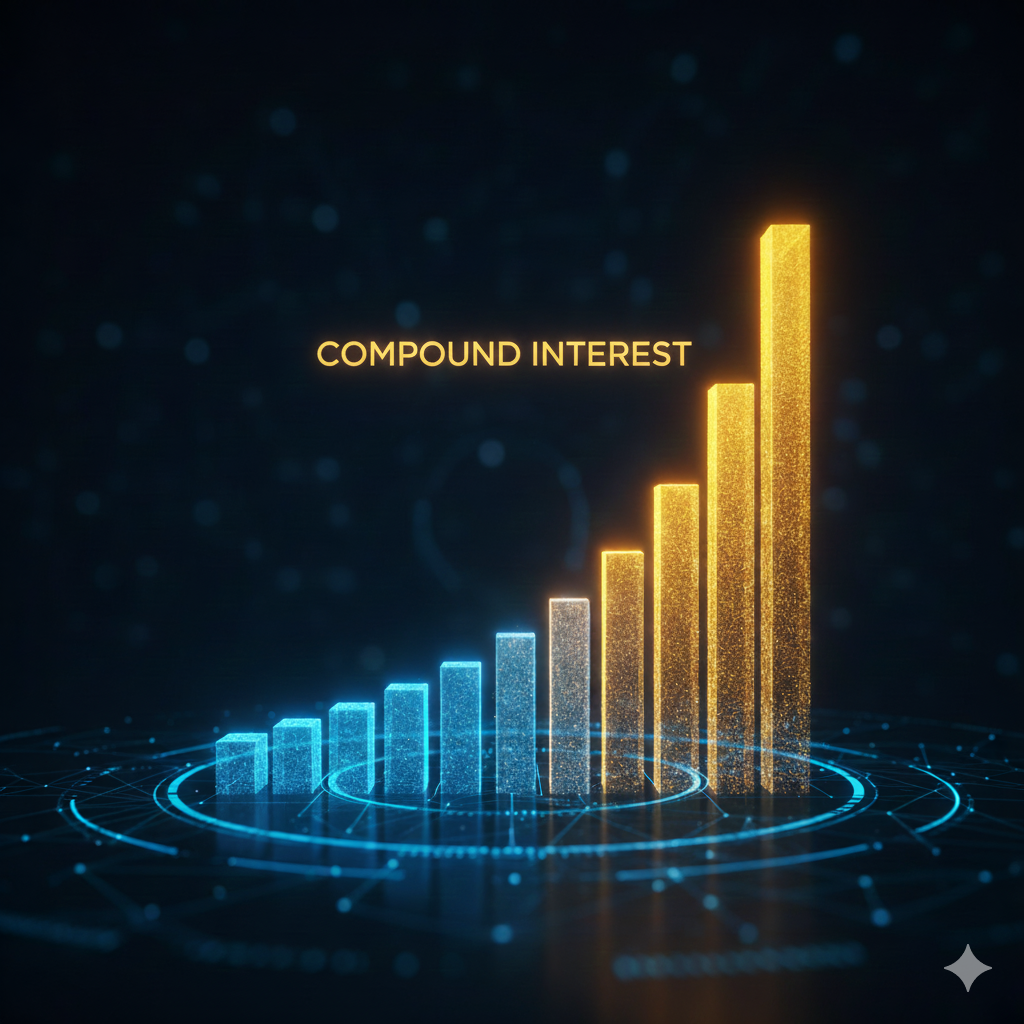
Albert Einstein is famously quoted as calling compound interest “the eighth wonder of the world.” He reportedly added, “He who understands it, earns it; he who doesn’t, pays it.”
In the world of personal finance and investing, compound interest is the most powerful force at your disposal. It is the engine that drives long-term wealth, allows small savings to grow into millions, and provides the foundation for a comfortable retirement. Yet, despite its importance, many people struggle to grasp how it actually works or how to leverage it effectively.
In this deep dive, we will peel back the layers of compounding, explain the math in simple terms, and show you exactly how to put this “financial superpower” to work for your future.
The Core Mechanics: Defining Compound Interest in Simple Terms

At its most basic level, compound interest is interest calculated on the initial principal, which also includes all of the accumulated interest from previous periods.
When you invest money, you earn interest (or returns) on that original amount. In the next period, you earn interest on both your original money and the interest you earned in the first period. Over time, this creates a “snowball effect.” As the snowball rolls down the hill, it picks up more snow, which increases its surface area, allowing it to pick up even more snow even faster.
The Two Components of Wealth
-
Principal: The original amount of money you invest or save.
-
Accumulated Interest: The “extra” money your principal has earned over time.
When these two work together, your money stops being a stagnant pile of cash and starts behaving like a productive employee that works 24/7 without a break.
Compound Interest vs. Simple Interest: Why the Difference Matters
To truly appreciate compounding, you must understand its predecessor: simple interest.
Simple Interest
Simple interest is only calculated on the principal amount. If you invest $1,000 at a 10% simple interest rate, you will earn $100 every year. After 30 years, you would have your original $1,000 plus $3,000 in interest, totaling $4,000. It is a linear, straight-line growth.
Compound Interest
With compound interest, the growth is exponential. Using that same $1,000 at a 10% rate:
-
Year 1: You earn $100 (Total: $1,100).
-
Year 2: You earn 10% of $1,100, which is $110 (Total: $1,210).
-
Year 3: You earn 10% of $1,210, which is $121 (Total: $1,331).
After 30 years, that same $1,000 would grow to over $17,449.
The difference between $4,000 and $17,449 is the “magic” of compounding. While the first few years feel slow, the gap between simple and compound interest widens drastically the longer you wait.
The Exponential Growth Curve: Why Time is Your Greatest Asset
The most important variable in the equation above is $t$ (time). Because it is an exponent, it has a disproportionate impact on the final result.
In the beginning stages of an investment journey, the growth looks flat. This is often called the “Lag Phase.” Many investors get discouraged here because they don’t see massive gains immediately. However, if you persist, you eventually hit the “inflection point,” where the curve turns upward sharply.
The Last 10 Years Rule
In a 30-year investment period, a huge portion of your total wealth is actually generated in the final 10 years. This is because your “snowball” is now so large that even a small percentage gain results in a massive dollar amount. This is why the best time to start investing was yesterday, and the second-best time is today.
Real-World Scenarios: The Cost of Delaying Your Investment Journey

Let’s look at a classic financial example involving two investors, Investor A and Investor B.
-
Investor A starts at age 25. They invest $5,000 a year for only 10 years and then stop contributing entirely. They let the money sit and compound at 8% until they are 65.
-
Investor B waits until they are 35. They invest $5,000 a year every single year for 30 years (until they are 65) at the same 8% rate.
The Results:
-
Investor A (who only invested $50,000 total) ends up with approximately $787,000.12
-
Investor B (who invested $150,000 total—three times as much money) ends up with approximately $611,000.34
Because Investor A gave their money an extra 10 years to compou5nd in the beginning, they ended6 up with more wealth despite contributing significantly less. This illustrates that time is more valuable than money when it comes to compounding.
The Rule of 72: A Shortcut to Calculating Your Future Millions
If you want a quick way to estimate how long it will take for your money to double, use the Rule of 72.
Simply divide 72 by your expected annual interest rate. The result is the approximate number of years it will take for your investment to double in value.
-
At a 6% return: $72 / 6 = 12$ years to double.
-
At an 8% return: $72 / 8 = 9$ years to double.
-
At a 12% return: $72 / 12 = 6$ years to double.
This mental math trick helps you understand the impact of even a 1% or 2% difference in your investment returns over the long haul.
The Best Investment Vehicles for Compound Interest
To take advantage of compounding, you need to be in assets that offer growth or reinvestment opportunities.
1. The Stock Market (Index Funds and ETFs)
Historically, the S&P 500 has returned an average of about 10% annually before inflation. By investing in low-cost index funds and reinvesting your dividends, you ensure that your gains are constantly being added back to your principal.
2. Dividend Reinvestment Plans (DRIPs)
Many stocks pay dividends (a share of the company’s profit). A DRIP automatically uses those dividends to buy more shares of the stock. This is compounding in its purest form: your shares produce more shares, which in turn produce even more shares.
3. High-Yield Savings Accounts (HYSA)
While they won’t make you a millionaire overnight, HYSAs are great for your emergency fund. Unlike a standard savings account, a high-yield account compounds monthly or daily at a much higher rate, ensuring your “safety net” grows over time.
4. Retirement Accounts (401k and IRA)
These accounts are “compounding on steroids” because of the tax advantages. In a Roth IRA, for example, your money compounds tax-free. You don’t have to pay the government a portion of your gains every year, meaning more money stays in the account to compound.
The Double-Edged Sword: When Compound Interest Works Against You

It is vital to remember that compounding doesn’t care if you are earning money or owing money. It works the same way for debt.
Credit Card Debt
Credit cards are the most dangerous form of compound interest. Most cards compound daily at rates between 18% and 29%. If you only pay the “minimum balance,” the interest you owe today will earn interest tomorrow. This is how a $1,000 purchase can turn into a $5,000 debt over a few years.
Loans and Amortization
While mortgages and auto loans usually use “amortized” interest (which is slightly different), the principle remains: the longer you take to pay off a loan, the more the interest compounds against you.
The Impact of Taxes and Inflation on Your Compound Returns
To be a sophisticated investor, you must distinguish between Nominal Returns and Real Returns.
-
Inflation: If your investment grows by 7% but inflation is 3%, your “Real” growth is only 4%. Inflation is “reverse compounding”—it reduces the purchasing power of your future dollars.
-
Taxes: If you have to pay 15-20% in capital gains taxes every time your investment earns money, you are removing “snow” from your snowball. This is why tax-advantaged accounts (like the 401k or IRA) are so critical for maximizing the power of compound interest.
Actionable Strategies to Maximize the Power of Compounding
How can you ensure you are getting the most out of this financial phenomenon? Follow these three steps:
1. Start Early (Stop Waiting for the “Perfect” Time)
Don’t wait until you have a “real” salary or a “big” amount to invest. Start with $50 or $100. The time the money spends in the market is more important than the amount you start with.
2. Reinvest Everything
If your investments pay dividends or interest, do not withdraw them to spend. Set your brokerage account to “Automatically Reinvest.” This ensures your “n” (frequency) remains high and your principal is constantly growing.
3. Minimize Fees
High management fees are the “kryptonite” of compound interest. A 1% management fee might sound small, but over 30 years, it can eat up nearly 25% to 30% of your total potential wealth. Stick to low-cost index funds and ETFs.
Patience is the Ultimate Investment Strategy

Compound interest is not a “get rich quick” scheme. It is a “get very rich slowly” system. It requires two things that are often in short supply: discipline and patience.
The math is undeniable. If you give your money enough time, and you don’t interrupt it unnecessarily, it will grow into a fortune. Your job is simply to provide the “snow” (the principal) and the “hill” (the time). The laws of mathematics will handle the rest.
By understanding how compound interest works—and respecting its power in both investments and debt—you are already ahead of 90% of the population. Start today, stay the course, and let the eighth wonder of the world build the life you’ve always dreamed of.