Why do people have difficulty saving money?

For many, the advice to “just save money” feels about as helpful as being told to “just be happy.” If it were that simple, everyone would have a six-month emergency fund and a thriving retirement account. Instead, the reality is that the majority of people live paycheck to paycheck, struggling to set aside even a small percentage of their income.
Why is it so difficult? Is it a lack of willpower? A lack of education? Or is something more profound at play? The truth is that the difficulty of saving money is a multi-dimensional problem. It is a perfect storm of biological evolution, psychological biases, sophisticated marketing, and a changing economic landscape. To conquer the saving struggle, we must first deconstruct the barriers that stand in our way.
The Evolutionary Paradox: Why Your Brain Isn’t Built for Saving

To understand why you find it hard to save, we have to look back at our ancestors. For the vast majority of human history, “saving” wasn’t a survival strategy. If our ancestors found a beehive full of honey or a patch of berries, the best move was to consume those calories immediately. Resources were scarce, and there was no way to “store” wealth for a 40-year retirement.
The Present Bias
Evolution favored those who focused on immediate survival. This has left us with what psychologists call “Present Bias”—the tendency to overvalue immediate rewards while significantly undervaluing future ones. Your brain views your “future self” almost as a stranger. When you decide to buy a new gadget today instead of putting that money into a 401(k), your brain is prioritizing the “real” person (you now) over the “stranger” (you in 30 years).
The Conflict of the Two Brains
Our financial decisions are a constant tug-of-war between two parts of the brain:
-
The Limbic System: This is the older, impulsive part of the brain. it seeks immediate gratification and is responsible for the “dopamine hit” you feel when you make a purchase.
-
The Prefrontal Cortex: This is the newer, rational part of the brain responsible for complex planning and logic.
When you see a “Limited Time Offer,” your limbic system screams for action, often overriding the prefrontal cortex’s quiet suggestion to stay within your budget.
Hyperbolic Discounting: The Psychological War Between Your Present and Future Self
One of the most powerful psychological barriers to saving is a phenomenon known as Hyperbolic Discounting. This is a cognitive bias where people choose smaller, immediate rewards over larger, later rewards.
The Marshmallow Test in Real Life
Think of the famous “Marshmallow Test” where children were offered one marshmallow now or two if they could wait fifteen minutes. As adults, our marshmallows are a night out, a new pair of shoes, or a car upgrade. We know that if we wait and invest that money, we will have much more in the future, but the “discount” we apply to that future reward is so steep that the single marshmallow today feels more valuable.
The mathematical impact of failing to overcome this bias is staggering. When we don’t save, we miss out on the power of compound interest—what Albert Einstein reportedly called the eighth wonder of the world.
The formula for the future value of an investment is:
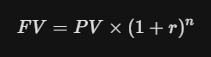
Where:
-
FV is the future value.
-
PV is the present value (the money you save today).
-
r is the interest rate.
-
n is the number of periods (years).
Every time we choose the immediate reward, we aren’t just spending the $PV$; we are effectively “burning” the $FV$ that could have existed.
The Dopamine Trap: How Modern Consumerism Hijacks Your Nervous System
We don’t live on the savanna anymore, but our biology hasn’t changed. Modern marketers and tech companies understand this perfectly. They have spent billions of dollars engineering environments that hijack our dopamine pathways to encourage spending.
The Gamification of Shopping
Online retailers have mastered the art of removing “friction” from the buying process. One-click ordering, saved credit card info, and biometric payments ensure that you don’t have time for your prefrontal cortex to catch up. The “add to cart” button provides a small hit of dopamine, and the confirmation email provides another. By the time the “pain of paying” sets in, the transaction is already over.
Targeted Temptation
Algorithms now know your weaknesses better than you do. If you’ve been feeling stressed and usually buy comfort items, social media platforms will show you exactly those items. We are fighting an asymmetrical war: our individual willpower against some of the most powerful artificial intelligences on earth designed to make us spend.
Social Comparison and the “Status Game”: The Financial Cost of Belonging

As social animals, our survival once depended on our status within the tribe. Today, that status is often signaled through material possessions. This leads to the phenomenon of “Keeping up with the Joneses.”
Relative Wealth vs. Absolute Wealth
Most people don’t care about how much they have in absolute terms; they care about how much they have relative to their peers. If your friends all drive luxury cars and go on expensive vacations, your perfectly functional car and modest staycation feel like a failure.
The Instagram Effect
In the past, we only compared ourselves to our immediate neighbors. Now, thanks to social media, we compare our “behind-the-scenes” reality to the “highlight reels” of everyone else in the world. This creates a constant sense of lack, which we try to fill by spending money on things that help us maintain a certain image.
The Economic Reality: When Low Wages and Inflation Collide
It would be empathetic and candid to acknowledge that for many, the difficulty in saving isn’t just psychological—it’s structural. We cannot discuss the “difficulty of saving” without looking at the actual cost of living.
The “Vimes’ Boots” Theory
Coined by author Terry Pratchett, the “Vimes’ Boots Theory of Socioeconomic Unfairness” explains that it is expensive to be poor. A wealthy person can buy a $50 pair of boots that lasts ten years. A poor person can only afford $10 boots that last a season, spending $100 over that same decade and still having wet feet.
When you are living on the edge, you don’t have the luxury of buying in bulk, waiting for sales, or investing in high-quality items that save money over time.
Inflation and Stagnant Wages
In recent years, the cost of housing, healthcare, and education has outpaced wage growth in many regions. When the “basics” consume 90% of your income, saving becomes a Herculean task.
As shown in Maslow’s hierarchy, if your physiological and safety needs (food, rent, health) are not fully secured, the higher-level thinking required for long-term financial planning is physically and mentally exhausting to maintain.
Money Scripts and Emotional Spending: Uncovering Your Subconscious Financial Bias

Every person has a “Money Script”—a set of subconscious beliefs about money formed in childhood. These scripts often dictate our ability to save.
Common Money Scripts
-
Money Avoidance: Believing that money is “dirty” or that wanting it makes you a bad person. These individuals often subconsciously “get rid” of money as soon as they earn it.
-
Money Status: Equating net worth with self-worth. This leads to overspending to maintain an image.
-
Money Vigilance: Being overly anxious about money. While this helps with saving, it can lead to a “scarcity mindset” that prevents healthy spending or investing.
Shopping as Self-Medication
For many, spending is an emotional regulator. When we feel sad, angry, or lonely, the act of buying something provides a temporary “high” or a sense of control. This is “Retail Therapy,” and it is one of the hardest habits to break because it provides a genuine, albeit temporary, relief from emotional pain.
Financial Illiteracy and the Complexity of Modern Banking Systems
Finally, many people struggle to save simply because the financial world is intentionally complex. From “Buy Now, Pay Later” (BNPL) services that hide the true cost of debt to credit card rewards that encourage higher spending, the system is not designed to help you keep your money.
The Lack of Education
In many school systems, personal finance is not taught. People enter the workforce without understanding taxes, interest rates, or the difference between an asset and a liability. This lack of knowledge makes people vulnerable to high-interest debt, which is the ultimate “saving killer.”
Strategies to Overcome Inaction and Build a Permanent Saving Habit
Understanding why it’s hard is the first step. The second step is to build systems that work with your brain’s limitations rather than trying to fight them with pure willpower.
1. Automate Everything
Since our brains are bad at making the decision to save every month, remove the decision entirely. Set up an automatic transfer from your paycheck directly to a savings or investment account. If the money is gone before you see it, you will naturally adjust your spending to the remainder.
2. The 72-Hour Rule
To defeat the dopamine trap of impulsive shopping, implement a mandatory 72-hour waiting period for any non-essential purchase. Most of the time, the emotional urge will fade within three days, and the prefrontal cortex will realize the item isn’t necessary.
3. Reframe Wealth
Shift your definition of wealth from “what you spend” to “what you keep.” A person earning $200k who spends $200k is not wealthy; they are one paycheck away from disaster. A person earning $60k who saves $10k is on the path to true freedom.
4. Practice “JOMO” (The Joy of Missing Out)
Instead of FOMO, embrace the joy of staying in, cooking at home, and watching your bank account grow. Realize that most people who “look” rich are actually drowning in debt.
Saving is a Skill, Not a Personality Trait

If you have struggled to save money, stop blaming yourself for a lack of character. You are fighting against millions of years of evolution, a global marketing machine, and a challenging economy.
Saving money is a skill that must be practiced and a system that must be built. By understanding the psychological and biological forces at play, you can stop fighting yourself and start designing a financial life that prioritizes your future security over temporary impulses. True wealth isn’t about deprivation; it’s about the peace of mind that comes from knowing you are in control of your resources.