Why investing is the best long-term strategy

In the journey of personal finance, there is a fundamental crossroad every individual faces: what to do with their hard-earned money. Most people are taught to work for money, but only a few learn how to make their money work for them. While saving money in a bank account provides a sense of security, it is rarely the path to true financial freedom.
In the modern economic landscape, investing has emerged as the most reliable and powerful strategy for long-term wealth accumulation. Whether you are planning for retirement, saving for a child’s education, or aiming for early financial independence, understanding why investing outperforms all other financial habits is crucial.
This guide will break down the mechanics of the market, the psychology of growth, and the undeniable mathematical proof that makes investing the ultimate long-term play.
The Invisible Thief: Why Beating Inflation is a Necessity

To understand why investing is the best strategy, we must first identify the primary enemy of your wealth: Inflation. Often called the “invisible thief,” inflation represents the gradual increase in the price of goods and services over time.
How Inflation Erodes Your Savings
If you hide $10,000 under your mattress today, it will still be $10,000 in twenty years. However, its purchasing power will be significantly lower. If inflation averages 3% per year, your $10,000 will buy roughly half of what it can buy today in just over two decades.
Investing as an Inflation Hedge
Standard savings accounts typically offer interest rates that struggle to keep pace with inflation. By investing in assets such as stocks, real estate, or commodities, you are putting your capital into vehicles that historically outpace the rate of inflation. Investing isn’t just about “getting rich”; it’s about ensuring that your future self has the same—or better—buying power than you have today.
The Eighth Wonder of the World: Harnessing the Power of Compounding
Albert Einstein reportedly called compound interest the “eighth wonder of the world.” For the long-term investor, compounding is the engine that transforms small, consistent contributions into massive fortunes.
The Mechanics of the Snowball Effect
Compound interest is the process where your investment returns begin to earn their own returns. In the beginning, the growth feels slow. However, as the years pass, the interest earned on your interest starts to outweigh your original contributions.
Time in the Market vs. Timing the Market: A Data-Driven Approach
One of the most common reasons people hesitate to invest is the fear of a “market crash.” They wait for the “perfect time” to enter the market, hoping to buy at the absolute bottom. History proves that this is a losing game.
The Failure of Market Timing
Trying to time the market requires two perfect decisions: knowing when to get out and knowing when to get back in. Missing just a few of the market’s best days can devastatingly reduce your long-term returns.
The Power of Persistence
The most successful investors aren’t those who predict the next recession, but those who stay invested through every recession. Over the last century, despite world wars, pandemics, and economic depressions, the S&P 500 has returned an average of roughly 10% annually. Long-term investing relies on the fact that the global economy has an inherent bias toward growth and innovation.
Diversification: The Only “Free Lunch” in Finance

If the stock market is a sea of volatility, diversification is your life jacket. Investing is the best long-term strategy because it allows you to spread your risk across thousands of companies, industries, and geographic regions.
Avoiding “Single-Point Failure”
When you put all your money into a single stock, you are gambling on one company’s management and luck. When you invest in a broad-market Index Fund or ETF (Exchange-Traded Fund), you are betting on the entire economy. While one company might go bankrupt, it is extremely unlikely that the top 500 companies in the world will all go bankrupt at once.
Strategic Asset Allocation
A long-term strategy involves more than just stocks. By including bonds, real estate (REITs), and perhaps even alternative assets, you create a portfolio that can weather different economic seasons. When stocks are down, bonds may be up, providing a “cushion” that keeps your emotional state stable enough to stay the course.
The Psychological Advantage: Automating Your Path to Wealth
Investing is as much a psychological challenge as it is a financial one. One of the reasons it works so well over the long term is that it allows for automation.
Dollar-Cost Averaging (DCA)
By setting up an automated transfer from your paycheck to your brokerage account, you are practicing Dollar-Cost Averaging. This means you buy more shares when prices are low and fewer shares when prices are high. This removes the emotional stress of “is today a good day to buy?” and ensures that you are consistently building your position regardless of the headlines.
Overcoming Decision Fatigue
In our daily lives, we make hundreds of decisions that drain our willpower. By automating your investment strategy, you turn wealth-building into a background process. Over 10, 20, or 30 years, this discipline becomes a lifestyle that requires zero daily effort but yields maximum results.
Historical Performance: A Century of Evidence
If we look at the history of the modern financial system, the evidence in favor of investing is overwhelming. Since its inception in 1926, the S&P 500 has seen more “up” years than “down” years.
The Resilience of the Market
Market crashes are often described in the media as “catastrophes,” but to a long-term investor, they are merely “blips” on an upward-trending line.
-
The 2008 Financial Crisis: Stocks recovered and hit new highs within a few years.
-
The 2020 Pandemic: Despite a massive drop, the market saw a record-breaking recovery.
This historical resilience is the reason why major institutions, pension funds, and university endowments place their trust in the markets. They aren’t looking at what happens next Tuesday; they are looking at what happens over the next thirty years.
Tax Advantages: Why Governments Want You to Invest
In many jurisdictions, including the United States, the tax code is heavily weighted in favor of investors over earners. This is a crucial “hidden” reason why investing is the superior strategy.
Capital Gains vs. Income Tax
Your salary is typically taxed as “ordinary income,” which carries higher tax brackets. However, if you hold an investment for more than a year, the profit is often taxed at the “Long-Term Capital Gains” rate, which is significantly lower.
Tax-Advantaged Accounts
Vehicles like the 401(k) and IRA (Individual Retirement Account) allow your money to compound either tax-deferred or tax-free.
-
401(k): You invest pre-tax dollars, lowering your taxable income today.
-
Roth IRA: You invest after-tax dollars, but your withdrawals in retirement are completely tax-free.
Utilizing these accounts effectively can add hundreds of thousands of dollars to your final net worth simply by reducing the “tax drag” on your compounding.
Investing in Yourself: The Highest ROI Asset
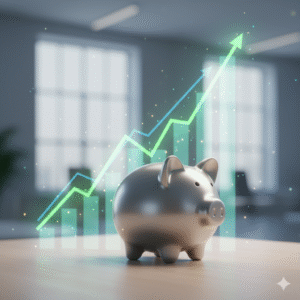
While the stock market and real estate are vital, no long-term strategy is complete without mentioning the investment in human capital.
Your ability to earn is your most significant asset during the first half of your financial journey. Investing in your education, skills, and health increases your “input” into your investment accounts. If you can increase your income through a new certification or business venture, you have more capital to feed into the “compounding machine.”
Common Risks and How to Mitigate Them
No discussion on investing would be honest without addressing risk. However, the risk of not investing is often greater than the risk of the market.
-
Market Volatility: Prices will go up and down. Solution: Maintain a long-term horizon and don’t look at your balance every day.
-
Liquidity Risk: Needing money when the market is down. Solution: Always maintain an Emergency Fund (3–6 months of expenses) in a high-yield savings account so you never have to sell your investments in a panic.
-
Inflation Risk: The risk that your returns don’t beat inflation. Solution: Invest in equities and real estate rather than just “safe” bonds or cash.
Trading Your Current Self for Your Future Freedom
Investing is not about greed; it is about freedom. It is the recognition that while you may be young and capable of working today, there will come a day when you want to—or need to—stop.
The best long-term strategy is built on the pillars of time, discipline, and diversification. By starting early, ignoring the “noise” of the daily news, and allowing the global economy to work in your favor, you are not just saving money; you are buying back your time.
Wealth is not the number of things you own; it is the number of days you can live without working. Investing is the only bridge that takes you from the “treadmill” of active income to the “oasis” of financial independence.