What is the stock market and how does it work?

For many, the stock market feels like a scene from a Hollywood movie—fast-talking traders, flashing screens, and a language that sounds more like secret code than financial advice. You hear about “bulls,” “bears,” and “short selling,” and it’s easy to feel like the door is locked to anyone without a finance degree.
But strip away the jargon and the complex software, and you’ll find that the stock market is actually one of the most elegant and accessible systems ever created. It is essentially a giant marketplace where regular people can own a piece of the world’s most successful companies.
In this guide, we are going to demystify the stock market from the ground up. Whether you have $10 or $10,000, understanding these fundamentals is your first step toward true financial independence.
What Exactly is the Stock Market? Understanding the “Marketplace”

At its simplest level, the stock market is a “supermarket” for businesses. Just as you go to a grocery store to buy apples or milk, you go to a stock exchange to buy and sell ownership in corporations.
When a company wants to grow—perhaps to build new factories, hire more staff, or develop new technology—it needs money (capital). Instead of taking out a massive bank loan, the company can choose to “go public” by issuing shares.
Each share represents a tiny piece of ownership in that company. If a company has 1,000 shares and you own one, you own 0.1% of that business. The “Stock Market” is the umbrella term for the collection of exchanges and markets where these shares are traded daily.
The Evolution from Physical Floors to Digital Clouds
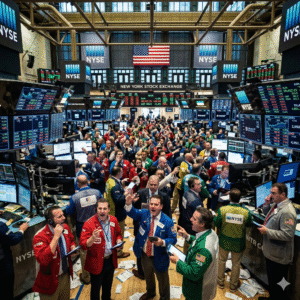
In the past, the stock market was a physical place. The famous New York Stock Exchange (NYSE) featured a “trading floor” where people shouted orders at each other. Today, the vast majority of trading happens electronically. Servers located in high-tech data centers execute millions of trades per second, making the market more efficient and accessible than ever before.
How the Stock Market Works: The Primary vs. Secondary Market
To understand the mechanics of the market, you have to distinguish between where stocks are born and where they are traded.
1. The Primary Market (The IPO)
This is where a company is born into the public world. Through a process called an Initial Public Offering (IPO), a private company sells its shares to the public for the first time. The money raised during an IPO goes directly to the company to help it grow. As a regular investor, you rarely participate in the IPO itself; that is usually reserved for big banks and institutional investors.
2. The Secondary Market (The Exchange)
This is where the rest of us live. Once the IPO is over, the shares start trading on the secondary market—the NYSE or the NASDAQ. When you “buy Apple stock” today, you aren’t buying it from Apple; you are buying it from another investor who already owns it and wants to sell. The company is no longer involved in the transaction, but the price of their stock reflects how the public feels about their business.
Why Do Companies “Go Public”? The Motivation Behind the Ticker
Why would a founder want to sell pieces of their “baby” to strangers? There are several strategic reasons:
-
Raising Capital: This is the big one. Publicly selling shares provides a massive influx of cash that doesn’t have to be paid back like a loan.
-
Liquidity for Founders: Going public allows early investors and employees to sell their shares and turn their hard work into actual cash.
-
Brand Prestige: Being listed on a major exchange provides a level of “street cred.” It tells the world that the company has passed rigorous regulatory checks.
-
Acquisition Currency: Public companies can use their own stock as “money” to buy other companies.
The Law of Supply and Demand: What Makes Stock Prices Move?
The question every beginner asks is: “Why did the price go up today?” The answer is always the same: Supply and Demand.
If more people want to buy a stock (Demand) than there are people willing to sell it (Supply), the price goes up. If everyone is trying to sell and no one wants to buy, the price goes down. But what influences that demand?
1. Earnings and Growth
Wall Street loves profit. Every three months, public companies release “Earnings Reports.” If a company makes more money than expected, demand for the stock usually rises.
2. Macroeconomics
Interest rates, inflation, and unemployment all affect the market. For example, when interest rates rise, borrowing money becomes more expensive for companies, which can hurt their profits and drive stock prices down.
3. Investor Sentiment (Psychology)
Sometimes, prices move based on fear or greed. If people feel like a recession is coming, they might sell their stocks even if the companies are doing well. This is why the market can be “irrational” in the short term.
Key Players in the Stock Market: Who Are You Trading With?
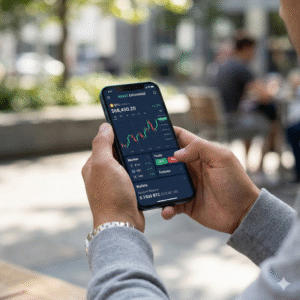
When you click “buy” on your phone, you are entering an ecosystem filled with different participants:
-
Retail Investors: That’s you. Individual people buying and selling for their personal accounts.
-
Institutional Investors: These are the “Big Fish”—pension funds, insurance companies, and mutual funds. They move millions of shares at a time and are the primary drivers of market movement.
-
Brokers: The “middlemen.” Companies like Fidelity, Charles Schwab, or Robinhood provide the platform that connects you to the exchange.
-
Market Makers: These are firms that stand ready to buy or sell a specific stock at any time, ensuring that there is always “liquidity” (the ability to trade without waiting).
Understanding Stock Market Indices: The S&P 500 and the Dow
You’ve probably heard news anchors say, “The market was up 2% today.” They aren’t talking about every single stock; they are talking about Indices.
An Index is a “sample” of the market used to measure its overall health.
-
The S&P 500: This tracks the 500 largest companies in the US. It is considered the best representation of the “total market.”
-
The Dow Jones Industrial Average (DJIA): This tracks 30 massive, “blue-chip” companies. It’s a bit old-fashioned but still widely followed.
-
The NASDAQ Composite: This is heavily weighted toward technology and innovation companies.
When an index is up, it means the majority of the big companies in that group had a good day.
Bull Markets vs. Bear Markets: Navigating the Cycles
The stock market moves in cycles, and investors use animal metaphors to describe the “mood” of the market.
The Bull Market (Optimism)
A Bull market is a period where stock prices are rising or expected to rise. Think of a bull’s horns—it strikes upwards. During a Bull market, the economy is usually strong, unemployment is low, and investors are confident.
The Bear Market (Pessimism)
A Bear market is defined as a drop of 20% or more from recent highs. Think of a bear’s paw—it strikes downwards. During a Bear market, investors are fearful, the economy may be slowing down, and people tend to “hibernate” by moving their money into safer assets like cash or bonds.
Note: Bear markets are a natural part of the cycle. Historically, they happen every few years, but they are almost always followed by even stronger Bull markets.
Different Types of Orders: How to Actually Buy a Stock
When you are ready to buy, you’ll see several options in your brokerage app. Understanding these is crucial to avoid overpaying.
-
Market Order: This tells the broker, “Buy this stock right now at whatever the current price is.” It’s the fastest way to trade, but you might pay a few cents more than you expected.
-
Limit Order: This tells the broker, “Only buy this stock if the price drops to X amount.” This gives you control over the price, but if the stock never hits that price, your trade won’t happen.
-
Stop-Loss Order: This is a safety net. It says, “If my stock drops to X price, sell it immediately so I don’t lose any more money.”
The Role of Dividends: Getting Paid to Wait
Not all the money in the stock market comes from the price going up. Some companies pay Dividends.
Imagine you own a piece of a profitable pizza shop. At the end of the year, after all the bills are paid, the owner gives you a small “thank you” check from the profits. That is a dividend.
-
Growth Stocks: Usually don’t pay dividends (e.g., Tesla or Amazon). They reinvest all profit back into the business.
-
Value Stocks: Often pay steady dividends (e.g., Coca-Cola or Johnson & Johnson). These are great for investors who want a steady stream of passive income.
The Risks of the Stock Market: What Beginners Must Know
While the stock market is a wealth-builder, it isn’t a “guaranteed” win. There are real risks involved:
-
Market Risk: The entire market can drop due to a recession or global event (like a pandemic).
-
Business Risk: You might pick a great company, but a competitor could release a better product, or the CEO could make a catastrophic mistake.
-
Inflation Risk: If your stocks grow by 3% but inflation is 5%, you are technically losing purchasing power.
-
Liquidity Risk: In very small, “penny” stocks, you might buy shares but find that there is no one willing to buy them from you when you want to sell.
Diversification: The “Free Lunch” of Investing
The best way to handle risk is Diversification. This is the financial version of “don’t put all your eggs in one basket.”
If you put all your money in one tech stock and that company has a scandal, you lose everything. But if you own an Exchange-Traded Fund (ETF) that holds 500 different companies across tech, healthcare, energy, and retail, a single company failing won’t ruin you.
-
The Strategy: For beginners, a “diversified” approach is always safer than trying to find a “diamond in the rough.”
How to Open Your First Account: A 5-Minute Roadmap
If you’re ready to stop watching and start participating, here is the process:
-
Choose a Brokerage: Look for one with $0 commissions and a good mobile app. (Fidelity, Vanguard, and Schwab are the industry titans).
-
Choose Your Account Type:
-
Standard Brokerage: You can withdraw money at any time, but you pay taxes on your gains.
-
Retirement Account (IRA/401k): Huge tax breaks, but you usually can’t touch the money until you are 59.5 years old.
-
-
Fund the Account: Transfer money from your bank account. Even $20 is a great start.
-
Buy Your First Asset: We recommend starting with a broad-market ETF (like VOO or VTI) before trying to pick individual stocks.
The Stock Market is a Marathon, Not a Sprint

The stock market is not a way to get rich overnight. It is a way to get wealthy over time. By understanding that you are buying pieces of real businesses—businesses that work every day to innovate and grow—you can trade your anxiety for a long-term strategy.
The most important thing isn’t how much money you start with; it’s when you start. The power of time is the greatest advantage any investor has. Open your account, stay diversified, and let the global economy work for you.