What happens if the stock market crashes?

The phrase “the market is crashing” is enough to send shivers down the spine of even the most seasoned investor. We’ve all seen the dramatic news reports: red arrows pointing straight down, frantic traders with their heads in their hands, and headlines warning of an impending economic apocalypse.
But what actually happens when the stock market “breaks”? Where does the money go? Does it simply vanish into thin air? And more importantly, what does a crash mean for you—the person with a retirement account, a mortgage, and a job?
In this comprehensive guide, we will explore the mechanics of a market crash, the “circuit breakers” designed to stop the bleeding, the ripple effects on the real economy, and how you can survive—and even thrive—when the sky starts falling.
Defining the “Crash”: The Difference Between a Correction and a Meltdown

Before we talk about the consequences, we have to define our terms. The stock market doesn’t just go “up” or “down”; it moves in specific technical phases.
Market Correction (10% Drop)
A correction is a decline of 10% or more from a recent peak. These are actually quite common and healthy. They act as a “reset button,” cooling down an overheated market where stock prices have become too high relative to actual company profits.
Bear Market (20% Drop)
When the market drops 20% or more, we enter a “Bear Market.” This is a more serious signal that investors are pessimistic about the future of the economy. Bear markets usually last longer than corrections and can be accompanied by a recession.
The Stock Market Crash
A crash is a sudden, dramatic, and often unexpected drop in stock prices. Unlike a slow-drifting bear market, a crash happens over a few days or even hours. It is characterized by panic selling, where everyone wants to exit at the same time, but there are no buyers on the other side.
The Mechanics of Panic: Why Markets “Break”
To understand what happens during a crash, you have to understand the role of liquidity. Liquidity is simply the ease with which you can turn an asset (like a stock) into cash.
In a normal market, liquidity is high. If you want to sell 100 shares of Apple, there are millions of buyers ready to take them. But during a crash, liquidity evaporates.
-
The Buyer Strike: When news is bad enough, potential buyers get scared. They step away from their computers.
-
The Falling Knife: Prices start to drop. As they drop, “stop-loss” orders (automated sell instructions) are triggered. This adds more sell orders to the pile, driving the price even lower.
-
The Feedback Loop: The lower the price goes, the more people panic. The more they panic, the more they sell. This is a self-reinforcing cycle that can “break” the normal functioning of the exchange.
The Role of Circuit Breakers: How Exchanges Stop the Bleeding
After the “Black Monday” crash of 1987, where the Dow Jones dropped 22.6% in a single day, regulators realized the market needed a “kill switch.” Today, the US stock exchanges use Circuit Breakers to prevent a total freefall.
These are mandatory pauses in trading that give investors a chance to breathe, read the news, and stop making emotional decisions. In the US, there are three levels:
-
Level 1 (7% Drop): Trading halts for 15 minutes.
-
Level 2 (13% Drop): Trading halts for another 15 minutes.
-
Level 3 (20% Drop): Trading is suspended for the rest of the day.
These pauses are designed to ensure that the market remains an orderly place to trade, rather than a scene of pure chaos.
The “Wealth Effect”: Why a Crash Hits Your Wallet (Even if You Don’t Trade)

You might think, “I don’t own stocks, so a crash doesn’t affect me.” Unfortunately, the stock market and the “real economy” are deeply intertwined through something economists call the Wealth Effect.
When the stock market is booming, people feel richer. Their 401(k) looks great, their home value is up, and they feel confident spending money on cars, vacations, and dinners. This spending fuels businesses, which then hire more people.
When the market crashes, the opposite happens:
-
Consumer Retrenchment: Even if you haven’t sold your stocks, seeing your account balance drop by 30% makes you feel “poorer.” You cancel the vacation and delay buying the new car.
-
The Spending Slowdown: When millions of people stop spending at the same time, businesses lose revenue.
-
Layoffs and Unemployment: To save money, businesses cut costs. This leads to job losses, which further reduces spending, potentially leading to a full-blown recession.
Systemic Risks in 2026: AI, Algorithmic Trading, and Flash Crashes
As we navigate the markets in 2026, the nature of “crashing” has changed. We are no longer just dealing with human panic; we are dealing with Algorithmic Trading and Artificial Intelligence.
Today, over 80% of stock market volume is driven by computer programs. These “algos” can execute trades in microseconds.
-
The Flash Crash: An algorithm might see a specific price pattern and decide to sell. Other algorithms, seeing that sell order, react by selling as well. This can cause a “Flash Crash” where a stock drops 10% and bounces back in the span of three minutes.
-
AI Hallucinations: In 2026, AI-driven sentiment analysis scans social media and news feeds. If a fake, AI-generated news story about a major CEO or a geopolitical event goes viral, algorithms might trigger a massive sell-off before a human has even had time to verify the facts.
Understanding that the market is now a “digital battlefield” is essential for modern investors.
Where Does the Money Go? Understanding “Paper Losses”
When the market capitalization of the S&P 500 drops by $2 trillion in a day, people often ask: “Who took that money?”
The answer is: No one.
Wealth in the stock market is “perceived value.” If you own a house and your neighbor sells an identical house for $500,000, your house is worth $500,000. If a month later, a neighbor sells their house for $400,000, your house is now “worth” $400,000.
The $100,000 didn’t go into someone’s pocket; the market’s opinion of your house’s value simply changed. In the stock market, these are called unrealized losses (or paper losses). The money only truly “disappears” if you sell your shares at that lower price, locking in the loss.
The Role of the Federal Reserve: The “Lender of Last Resort”
When the market “breaks” and threatens to take the whole economy down with it, a powerful player steps in: The Federal Reserve (The Fed).
The Fed has several tools to fight a crash:
-
Lowering Interest Rates: By making it cheaper to borrow money, the Fed encourages businesses to invest and consumers to spend.
-
Quantitative Easing (QE): The Fed can literally “print” money to buy government bonds and other assets. This injects cash (liquidity) back into the system, ensuring that banks have enough money to keep lending.
-
The “Fed Put”: This is a psychological concept where investors believe the Fed will always step in to save the market if things get too bad. While this provides a safety net, it can also lead to “Moral Hazard,” where investors take too much risk because they think they won’t be allowed to fail.
Historical Precedents: What We Learned from 1929, 2008, and 2020

To understand the future, we must look at the “Big Three” market meltdowns of the last century.
The Great Crash of 1929
This was the worst-case scenario. It wasn’t just a crash; it was a decade-long disaster. Because there were no “circuit breakers” and the Fed didn’t intervene properly, the crash led to the Great Depression. It took 25 years for the market to return to its pre-crash levels.
The Great Recession of 2008
This was caused by a “bubble” in the housing market. When the bubble burst, it took down the global banking system. This taught us about “Systemic Risk”—how a problem in one small part of the economy (subprime mortgages) can infect everything else.
The COVID-19 Crash of 2020
This was the fastest crash in history. The market dropped 30% in a month. However, because the government and the Fed acted with unprecedented speed (the “Bazooka” approach), the recovery was also the fastest in history.
Strategies to Protect Your Wealth During a Market Meltdown
You cannot predict a crash, but you can prepare for one. Here is how the “smart money” protects itself:
1. Diversification (The Only Free Lunch)
Don’t just own US tech stocks. Own international stocks, bonds, real estate, and commodities (like gold). When stocks crash, “Safe Haven” assets like Gold or US Treasury Bonds often go up in value, balancing out your losses.
2. The “Cash Bucket” Strategy
If you are nearing retirement, keep 2-3 years of living expenses in a high-yield savings account or “Cash Equivalents.” This ensures that if the market crashes, you don’t have to sell your stocks at the bottom to pay your bills. You can simply live off your cash and wait for the recovery.
3. Rebalancing
Once a year, look at your portfolio. If your stocks have grown so much that they now make up 90% of your wealth, sell some and buy bonds. This forces you to “Sell High” during a boom and “Buy Low” during a crash.
4. Hedging with “Put Options”
Advanced investors use “Put Options” as insurance policies. A Put Option increases in value when the stock price falls. It’s like buying fire insurance for your house; you hope you never need it, but you’re glad you have it if the market catches fire.
The Psychological Trap: Why Humans are Wired to Fail in a Crash
The biggest enemy in a market crash isn’t the economy—it’s your own brain. Evolution has wired us with a “Fight or Flight” response. When we see our life savings dropping, our brain treats it like a physical threat (like a tiger attacking).
Our instinct is to “Run” (Sell).
-
The Pain of Loss: Psychologically, the pain of losing $1,000 is twice as powerful as the joy of gaining $1,000. This is called Loss Aversion.
-
Recency Bias: When the market is crashing, our brains tell us it will stay down forever. We forget that the market has recovered from 100% of its previous crashes.
The most successful investors are those who can detach their emotions from their computer screens. They view a crash not as a disaster, but as a “sale” on high-quality companies.
Is a Crash Coming? Recognizing the Red Flags
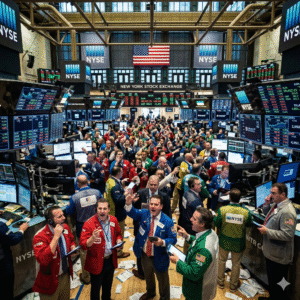
While no one has a crystal ball, there are certain “overheating” signals that often precede a crash:
-
Extreme Valuations: When the “Price-to-Earnings” (P/E) ratios of stocks are at all-time highs, the market is vulnerable.
-
Excessive Leverage: When everyone is borrowing money to buy stocks (trading on margin), a small dip can trigger a massive wave of forced selling.
-
“Euphoria” in the Media: When your taxi driver or a teenager on TikTok is giving you “can’t lose” stock tips, it’s usually a sign that the market is near a peak.
Why a Crash is Ultimately an Opportunity
If you are a long-term investor, a stock market crash is actually your best friend.
Imagine your favorite clothing store suddenly announced a “70% Off Everything” sale. You wouldn’t run away in fear; you would grab your wallet and head to the store. The stock market is the only place in the world where people run away when things go on sale.
What happens when the stock market breaks? The weak hands sell, the strong hands buy, and the cycle of wealth creation begins anew. By understanding the mechanics, staying diversified, and controlling your emotions, you can turn a market “catastrophe” into the greatest financial opportunity of your life.