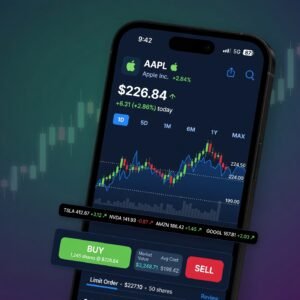
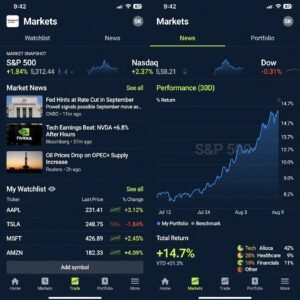
Is now a good time to invest in the stock market?

One of the most frequent questions financial advisors and experts hear is: “Is now the right time to buy?” Whether we are in the middle of a booming “Bull Market” or the depths of a “Bear Market,” the anxiety remains the same. Beginners fear buying at the peak, and they fear buying during a crash.
As we navigate the economic landscape of March 2026, the world looks different than it did just a few years ago. We’ve seen the “AI Gold Rush” move into its maturity phase, interest rates find a new plateau, and global trade routes redefine themselves.
In this exhaustive guide, we will break down the current market conditions, the psychology of “timing the market,” and why your personal financial timeline is actually more important than the headlines on the news today.
The 2026 Economic Outlook: Stability and the “New Normal”
To understand if “now” is a good time, we have to look at the macroeconomic backdrop. In early 2026, the global economy has largely moved past the extreme inflationary shocks of the early 2020s. We are currently in what many economists call the “Plateau Era.”
Interest Rates and Their Impact on Your Portfolio
Central banks, including the Federal Reserve, have moved away from the aggressive rate hikes of the past. In 2026, interest rates have stabilized. For an investor, this means the “cost of capital” is predictable. Companies can plan their expansions without fearing a sudden spike in debt costs.
Inflation vs. Growth
While the “hyper-inflation” scares are gone, we still see a steady 2-3% rise in prices. If you are sitting on cash in a standard bank account, you are effectively losing 2-3% of your wealth every single year. This makes the stock market not just an option, but a necessity for anyone looking to protect their purchasing power.
The Fallacy of “Timing the Market”: Why Waiting for a Dip Usually Fails
The biggest mistake beginners make is trying to wait for the “perfect” entry point. They tell themselves, “I’ll wait for a 10% drop, then I’ll buy.” The problem? The market might go up 20% while you are waiting for that 10% drop. You end up buying at a price much higher than where you started.
Time in the Market vs. Timing the Market
Data over the last 100 years is conclusive: the amount of time you spend in the market is far more important than the specific day you started.
-
The 10-Year Rule: If you look at any 10-year period in US stock market history, the probability of making money is incredibly high.
-
The “Best Days” Risk: As we’ve seen in recent years, the market’s biggest gains often happen in short, unpredictable bursts. If you miss just a few of the market’s “best days” because you were waiting on the sidelines, your long-term returns can be cut by half.
The AI Productivity Boom: Is the Tech Sector Overvalued in 2026?
In 2026, we are no longer just “talking” about Artificial Intelligence; we are seeing it in the bottom lines of every major corporation. This has led to high valuations in the tech sector, causing many to worry about a “bubble.”
The Infrastructure Phase vs. The Application Phase
The early 2020s were about building the “chips” and “servers” (the infrastructure). In 2026, we are in the Application Phase. We are seeing how retail, healthcare, and logistics companies are using AI to cut costs and skyrocket efficiency.
-
The Verdict: While some specific stocks might be “expensive,” the structural shift in productivity suggests that the growth is backed by real earnings, not just hype. Investing now means participating in the second wave of this technological revolution.
Why Your Personal Financial Situation is the Only “Clock” That Matters

The question isn’t just about the stock market; it’s about you. The “best time” to invest is defined by your personal balance sheet, not the S&P 500’s daily movement.
The Three Pillars of Investment Readiness
Before you put money into the market in 2026, you must check these three boxes:
-
High-Interest Debt: If you have credit card debt at 20% interest, pay that off first. No stock market return can consistently beat a 20% “guaranteed” loss on debt.
-
Emergency Fund: Do you have 3 to 6 months of living expenses in a high-yield savings account? This “peace of mind fund” ensures you never have to sell your stocks during a temporary market dip to pay for a car repair.
-
Long-Term Horizon: Is this money you won’t need for at least 5 years? If the answer is yes, then “now” is almost always a good time.
Understanding Volatility: Why Red Days are Actually “Sales”
Beginners often see a red day (prices going down) and feel a sense of panic. Experienced investors see a red day and see a discount.
In 2026, volatility is a feature of the market, not a bug. Because of high-frequency trading and AI algorithms, prices can move fast. But for the long-term investor, these fluctuations are noise.
The “Store” Analogy
Imagine your favorite clothing store had a “20% off everything” sale. You would run to the store. The stock market is the only place where people run away when things go on sale. If the market is down today, it is technically a “better” time to buy than it was yesterday.
Dollar-Cost Averaging (DCA): The Ultimate Strategy for “Bad Timing”
If you are still worried about buying at the “wrong” time, there is a simple mathematical solution: Dollar-Cost Averaging.
Instead of investing $10,000 all at once (Lump Sum), you invest $1,000 every month for 10 months.
-
If the market goes up, your early investments grow.
-
If the market goes down, your $1,000 buys more shares at a lower price.
DCA removes the emotional stress of timing. It turns “bad timing” into a strategy for lower average costs. In the volatile environment of 2026, DCA is the most recommended strategy for beginners.
The Best Sectors to Watch in 2026
While we recommend broad-market ETFs (like the S&P 500) for most beginners, it’s helpful to understand which sectors are driving the economy in 2026.
1. Energy Transition and “Green” Infrastructure
The shift to renewable energy is no longer a “future” project; it’s the current reality. Companies involved in grid modernization, battery storage, and nuclear energy are seeing massive government backing and private investment.
2. Cybersecurity in the AI Era
As AI becomes more powerful, so do cyber-attacks. Corporations and governments are spending record amounts on security. This makes the cybersecurity sector a “defensive” play—it’s something the world cannot afford to cut spending on, even in a recession.
3. Healthcare and Biotechnology
With an aging global population and the use of AI in drug discovery, the healthcare sector is experiencing a “Golden Age” of innovation. These companies often provide stability to a portfolio because people need medicine regardless of what the economy is doing.
Identifying the “Red Flags”: When You Should NOT Invest
Even though we generally say “the best time to start is now,” there are specific scenarios where you should stay on the sidelines:
-
Investing with Borrowed Money: Never use “margin” (loans from your broker) as a beginner. If the market drops, you can lose more than you started with.
-
Emotional Investing (FOMO): If you are buying a stock because you saw a “viral” video and you are afraid of missing out, stop. That is gambling, not investing.
-
Short-Term Needs: If you need this money for a house down payment in six months, keep it in a high-yield savings account or a Certificate of Deposit (CD). The stock market is too unpredictable over 6-month periods.
The Role of Diversification: Not Putting Your Eggs in One Basket
A “good moment to invest” only stays good if you are diversified. If you put all your money into one “hot” stock and that company has a scandal, you’ve made a mistake.
In 2026, diversification is easier than ever. By buying an Index Fund or ETF, you own a piece of hundreds of companies at once.
-
VOO (Vanguard S&P 500 ETF): Own the 500 largest US companies.
-
VTI (Vanguard Total Stock Market ETF): Own virtually every public company in the US.
-
VXUS (Vanguard Total International Stock ETF): Diversify outside of the US to capture growth in emerging markets.
Is Now a Good Moment?
Yes. Historically, the “best” time to invest is almost always “as soon as you have the money and the long-term mindset.” In 2026, with interest rates stabilized and technology driving a new wave of corporate efficiency, the “engine” of the stock market is strong.
The market has survived wars, pandemics, depressions, and political upheaval. In every single case, it has eventually reached new all-time highs. By starting today, you are giving yourself the gift of Time.
How to Get Started in 5 Simple Steps

If you’ve decided that now is your time, here is your roadmap:
-
Open a Brokerage Account: Look for “zero-commission” brokers that offer fractional shares.
-
Select Your “Core” Holding: Choose a broad-market ETF (like an S&P 500 index).
-
Set Up an Automatic Transfer: Automate your investing so it happens before you have a chance to spend the money.
-
Ignore the Daily “Noise”: Don’t check your account every day. Check it once every few months.
-
Reinvest Your Dividends: Ensure your “DRIP” (Dividend Reinvestment Plan) is turned on so your money grows even faster.
Don’t Let “Wait and See” Become Your Financial Strategy
The world will always provide a reason to be afraid. In 2026, there are geopolitical tensions, technological shifts, and environmental challenges. But there is also innovation, growth, and the relentless drive of businesses to generate profit.
The wealthy don’t wait for the “perfect” time; they create wealth by being consistent. If you have your emergency fund ready and a horizon of 5+ years, now is the best time to invest. Don’t look back in five years and wish you had started today.