Why investors panic during market downturns

The stock market is a sea of green and red. For most people, green represents progress, security, and the promise of a comfortable retirement. But when the screens turn red, and the headlines scream “Market Bloodbath” or “Economic Recession,” something primal takes over. Even the most seasoned investors can find themselves hovering over the “Sell” button, their hearts racing and their palms sweating.
But why? Why is it so difficult to “buy low and sell high” when the theory is so simple? The answer doesn’t lie in your spreadsheet or your brokerage app; it lies deep within the human brain.
In this article, we will explore the fascinating world of behavioral finance to understand why market volatility triggers panic, how our evolutionary biology works against our bank accounts, and what you can do to protect your wealth when everyone else is running for the exits.
The Biological Root of Market Panic: Fight or Flight in Finance

To understand why people panic during a market crash, we have to travel back thousands of years. Our ancestors lived in a world where sudden changes in the environment usually meant a life-or-death threat. A rustle in the grass could be a predator; a sudden change in the weather could mean famine.
The Role of the Amygdala
When the market drops 5% in a single day, your brain doesn’t see a “buying opportunity.” Your amygdala—the almond-shaped part of the brain responsible for processing fear—sees a threat to your survival. It triggers a “fight-or-flight” response. Since you can’t physically fight a stock index, the “flight” instinct takes over. In financial terms, flight means selling everything to “save” what is left.
Prefrontal Cortex vs. Amygdala
The prefrontal cortex is the part of the brain responsible for logic, math, and long-term planning. Under normal conditions, it’s in charge. However, during a market crash, the amygdala can effectively hijack the brain, shutting down logical thought in favor of raw survival instinct. This is why investors make irrational decisions that they regret just weeks or months later.
Loss Aversion: Why Losing $1,000 Hurts More Than Gaining $1,000
One of the most critical concepts in behavioral economics is Loss Aversion, a theory pioneered by psychologists Daniel Kahneman and Amos Tversky. Their research proved that the pain of a loss is psychologically twice as powerful as the joy of a gain.
The Mathematical Disconnect
If you find $1,000 on the street, you feel a certain level of happiness. If you then lose that same $1,000, your level of misery will be far greater than the initial happiness was. In the stock market, this means that a 10% drop in your portfolio feels significantly more impactful than a 10% gain.
Because we are wired to avoid pain at all costs, we often make the mistake of selling at the bottom just to “stop the bleeding.” We prioritize the immediate relief of ending the pain over the long-term logical goal of wealth accumulation.
The Herd Mentality: Why We Follow the Crowd Off the Cliff
Humans are social animals. For most of history, staying with the tribe meant safety, and being cast out meant death. This “herd mentality” is still hardwired into our behavior today, especially in the world of investing.
Social Proof and Market Bubbles
When everyone is buying a specific stock or cryptocurrency (the “Green” phase), we feel a social pressure to join in (FOMO). Conversely, when we see everyone else selling and read news reports about a “mass exodus” from the markets, our instinct tells us that the “herd” knows something we don’t.
The Feedback Loop
Panic is contagious. One large institutional sell-off triggers a headline, which triggers retail investors to sell, which drops the price further, triggering more headlines. This creates a feedback loop where the price of an asset becomes completely detached from its actual value, driven entirely by collective fear.
Recency Bias and the “End of the World” Fallacy
Recency Bias is the tendency to believe that what has happened recently will continue to happen in the future.
-
In a Bull Market, people believe stocks will go up forever, leading to over-leveraged positions and risky loans.
-
In a Bear Market, people believe the market will go to zero, leading to panic selling.
During a crash, investors lose sight of the long-term historical trend of the market. They forget that every single market crash in history has eventually been followed by a recovery and new all-time highs. They become trapped in the “now,” convinced that this time is different and the financial system is permanently broken.
The Role of Media and “Financial Doom-scrolling”

We live in the era of the 24-hour news cycle and instant smartphone notifications. Financial news outlets thrive on volatility because fear sells. A headline that says “Market Remains Stable for 10th Consecutive Year” gets no clicks. A headline that says “BILLIONS WIPED OUT AS CRASH LOOMS” generates massive revenue.
The Information Overload Trap
When investors “doom-scroll” through financial news during a downturn, they are constantly re-triggering their amygdala. This constant state of high alert makes it almost impossible to maintain a long-term perspective. Moreover, social media algorithms prioritize high-emotion content, meaning if you look at one “market crash” video, your feed will soon be flooded with dozens more, creating a distorted reality where total economic collapse feels inevitable.
The High Cost of Panic Selling: Lessons from History
Panic selling is perhaps the most expensive mistake an investor can make. When you sell during a crash, you do two things:
-
You lock in your losses, turning a “paper loss” into a permanent one.
-
You likely miss the best days of the recovery.
Missing the “Best Days”
Data from firms like J.P. Morgan Asset Management consistently show that the market’s best days often occur within weeks of its worst days. If an investor missed just the 10 best days of the S&P 500 over a 20-year period, their total return would be roughly half of what it would have been if they had simply stayed invested.
Panic-proof investing isn’t about being a genius; it’s about being patient. Historically, the market has spent more time going up than going down. A crash is a temporary dip in a long-term upward trajectory.
How to “Panic-Proof” Your Investment Portfolio
If you know your brain is wired to panic, the solution is to build a system that protects you from yourself.
1. Reassess Your Risk Tolerance (Before the Crash)
Many people think they have a high risk tolerance when the market is going up. True risk tolerance is how you feel when your account is down 30%. If you can’t sleep at night during a downturn, your portfolio is too aggressive. You may need to shift more assets into “defensive” sectors or bonds.
2. The Power of Asset Allocation
Asset allocation is your primary insurance policy against panic. By spreading your money across stocks, bonds, real estate, and cash, you ensure that even if one sector is crashing, your entire net worth isn’t being wiped out. This “cushion” makes it easier to stay calm and rational.
3. Maintain a Robust Emergency Fund
Most panic selling happens because people need the money. If you have 6 to 12 months of living expenses in a high-yield savings account, a market crash is just an abstract event on a screen. If you don’t have an emergency fund, a crash becomes a threat to your ability to pay rent or buy groceries, which forces you to sell at the worst possible time.
Automation: Why Robots are Better Investors Than Humans
The best way to take emotion out of investing is to take the “human” out of the equation. This is where Dollar-Cost Averaging (DCA) becomes your greatest ally.
What is Dollar-Cost Averaging?
DCA is the practice of investing a fixed amount of money at regular intervals, regardless of the price.
-
When prices are high, your money buys fewer shares.
-
When prices are low (during a crash), your money buys more shares.
By automating your investments through your 401(k) or brokerage account, you turn a market crash into a “sale.” Instead of panicking, your automated system quietly goes to work, buying up assets at a discount while everyone else is running away.
Using Insurance and Loans Strategically During Volatility
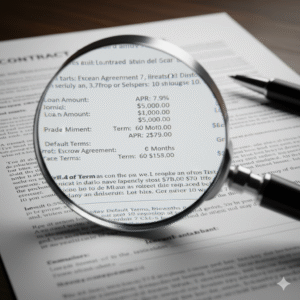
Market panic often spills over into other areas of personal finance, such as loans and insurance.
Credit Cards and High-Interest Debt
During a market crash, many people stop investing and start leaning on credit cards to cover expenses. This is a dangerous move. High-interest debt is the antithesis of wealth building. If you find yourself in this position, exploring a low-interest personal loan to consolidate debt might be a smarter move than selling your depreciated stocks to pay off a 24% APR credit card.
The Role of Life Insurance
For many, the fear of a market crash is tied to the fear of leaving their family unprotected. Having a solid life insurance policy provides a “legacy floor.” Knowing that your family is protected regardless of what happens to the S&P 500 can give you the psychological fortitude to keep your investments in the market during a downturn.
The Secret to Wealth is Temperament, Not Intellect
Warren Buffett famously said, “Investing is not a game where the guy with the 160 IQ beats the guy with 130 IQ. Once you have ordinary intelligence, what you need is the temperament to control the urges that get other people into trouble in investing.”
Panic is a natural, biological response, but it is a choice in the modern world. By understanding your brain’s triggers—from the amygdala’s fear response to the trap of loss aversion—you can begin to see market crashes for what they truly are: temporary hurdles on the path to long-term financial freedom.
The next time the markets turn red and the headlines turn dark, take a deep breath. Remember that you are playing a long game. Your future self will thank you for the silence, the patience, and the discipline you showed when everyone else was screaming.