Saving vs. investing: what’s the difference?
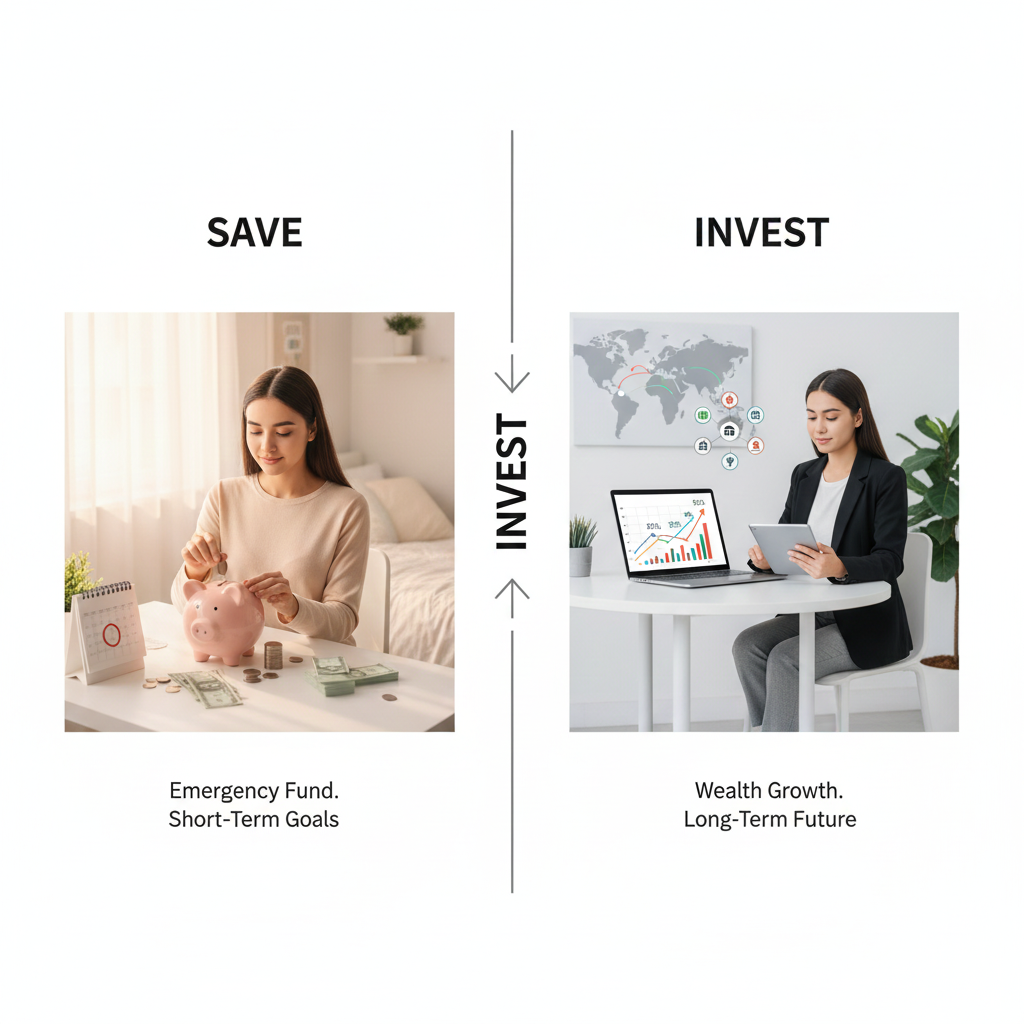
In the world of personal finance, the terms “saving” and “investing” are often used interchangeably. You might hear a friend say they are “saving for retirement” while they are actually buying stocks, or another say they are “investing in a savings account.” While both are essential components of a healthy financial life, they serve fundamentally different purposes, carry different risks, and lead to vastly different outcomes.
Understanding the nuance between saving vs. investing is the “holy grail” of wealth management. If you save when you should be investing, you lose money to inflation. If you invest when you should be saving, you risk losing capital you need for an emergency.
In this ultimate guide, we will break down the mechanics of both strategies, explore the psychological barriers to each, and provide a roadmap to help you decide where every dollar of your paycheck should go.
What is Saving? The Foundation of Financial Security

At its core, saving is the act of setting aside money for future use in a safe, liquid environment. When you save, your primary goal is capital preservation. You want to ensure that if you put $1,000 into an account today, you will have at least $1,000 (plus a tiny bit of interest) available to you whenever you need it.
The Characteristics of Saving:
-
Low Risk: Your money is typically held in FDIC-insured bank accounts, meaning it is virtually impossible to lose your principal.
-
High Liquidity: You can access your cash almost instantly. Whether it’s an ATM withdrawal or a quick transfer, the money is “liquid.”
-
Short-term Focus: Saving is generally for goals occurring within the next 1 to 3 years.
-
Lower Returns: Because the risk is low, the reward (interest) is also low.
What is Investing? The Engine of Wealth Creation
Investing is the process of using your money to buy assets that you believe will increase in value over time or generate income. Unlike saving, where you are a “lender” to the bank, when you invest, you become an “owner” or a “creditor” to a corporation, government, or piece of real estate.
The primary goal of investing is growth. You are willing to accept the risk that your $1,000 might fluctuate—dropping to $800 or rising to $1,200—in exchange for the potential to see that money compound into a much larger sum over a decade or more.
The Characteristics of Investing:
-
Higher Risk: There is no guarantee of return, and in some cases, you could lose your entire investment.
-
Lower Liquidity: Some investments, like real estate or certain bonds, can take weeks or months to convert back into cash.
-
Long-term Focus: Investing is designed for goals that are 5, 10, or 30 years away.
-
Higher Potential Returns: Historically, the stock market has returned significantly more than any savings account.
Saving vs. Investing: A Side-by-Side Comparison
To help you visualize the differences, let’s look at how these two pillars of finance compare across key categories:
| Feature | Saving | Investing |
| Primary Goal | Safety and Liquidity | Long-term Wealth Growth |
| Risk Level | Minimal / None | Moderate to High |
| Returns | Low (0.5% – 4.5% APR) | Higher (7% – 10% Historical Average) |
| Time Horizon | Short-term (0 – 3 years) | Long-term (5+ years) |
| Best For | Emergency funds, weddings, vacations | Retirement, college funds, legacy |
| Impact of Inflation | High (Purchasing power often decreases) | Low (Growth usually outpaces inflation) |
The Silent Wealth Killer: Why Saving Alone Isn’t Enough
Many people feel “safe” when they see a large balance in their savings account. However, there is a hidden danger known as Inflation. Inflation is the rate at which the general level of prices for goods and services rises, subsequently eroding purchasing power.
If the inflation rate is 3% and your savings account is only paying 1% interest, you are effectively losing 2% of your wealth every year. Your balance stays the same, but that money buys fewer groceries, less gas, and smaller homes.
This is why investing is not just a “luxury” for the wealthy; it is a necessity for anyone who wants to maintain their standard of living in the future. Investing allows your capital to grow faster than the cost of living, ensuring that your future self is wealthier than your current self.
When Should You Focus on Saving?
Before you buy your first share of an ETF or invest in a rental property, you must have a solid “Savings Base.” Financial experts generally recommend prioritizing savings in the following scenarios:
1. Building an Emergency Fund
Life is unpredictable. Cars break down, roofs leak, and jobs are lost. An emergency fund is 3 to 6 months of essential living expenses kept in a High-Yield Savings Account (HYSA). This fund prevents you from having to sell your investments at a loss or taking out high-interest personal loans when a crisis hits.
2. Saving for a Specific Purchase
If you plan to buy a home in two years, that down payment should not be in the stock market. A market downturn right when you find your dream home could force you to delay your purchase. For short-term goals, safety is more important than growth.
3. Hedging Against Market Volatility
As you approach retirement, you will likely shift more of your “invested” money back into “savings” (like CDs or Money Market accounts). This ensures that even if the market crashes, you have several years of cash on hand to live on without selling your stocks at the bottom.
When Should You Focus on Investing?

Once your emergency fund is set and your high-interest debt (like credit cards) is paid off, it’s time to put your money to work.
1. Planning for Retirement
Because retirement is usually decades away for most workers, time is your greatest asset. Through the power of Compound Interest, even small amounts invested in your 20s can grow into millions by your 60s.
2. Achieving “Financial Independence”
If your goal is to “retire early” or have the option to stop working, you cannot get there through a savings account. You need assets—stocks, bonds, or real estate—that generate passive income or appreciate in value.
3. Beating the Tax Man
Many investment vehicles, such as 401(k)s or IRAs, offer significant tax advantages. These accounts allow you to invest pre-tax money or grow your money tax-free, a benefit you won’t find with a standard savings account.
The Magic of Compound Interest: Why Time Matters More Than Timing
Albert Einstein famously called compound interest the “eighth wonder of the world.” To understand why you should transition from a saver to an investor as early as possible, consider this example:
-
Investor A starts at age 25, investing $500 a month with a 7% annual return. By age 65, they have approximately $1.2 million.
-
Investor B starts at age 35, investing the same $500 a month with the same 7% return. By age 65, they have approximately $580,000.
By waiting just 10 years to start, Investor B ends up with half the wealth, despite only contributing $60,000 less in total principal. This is the “cost of waiting.” Savings accounts simply do not have the interest rates required to trigger this level of exponential growth.
Understanding Your Risk Tolerance: The “Sleep at Night” Test
The biggest reason people avoid investing and stick to saving is fear. Watching your account balance drop during a market correction is painful. To be a successful investor, you must determine your Risk Tolerance.
-
Aggressive Investors: Comfortable with high volatility in exchange for high returns. They usually hold a higher percentage of stocks.
-
Conservative Investors: Prefer stability and are willing to accept lower returns to avoid big losses. They usually hold more bonds and cash.
A common mistake is being too conservative when you are young. If you have 30 years until retirement, a market crash today is irrelevant to your long-term success. In fact, for a young person, a market crash is a “sale” that allows you to buy more shares at a lower price.
Common Financial Vehicles for Savers and Investors
For Savers:
-
High-Yield Savings Accounts (HYSA): Offers higher interest than traditional banks while remaining fully liquid.
-
Certificates of Deposit (CDs): Locks your money for a set term (e.g., 1 year) in exchange for a slightly higher interest rate.
-
Money Market Accounts: A hybrid between checking and savings, often offering competitive rates.
For Investors:
-
Index Funds and ETFs: Low-cost ways to own a piece of hundreds of companies at once.
-
Individual Stocks: Higher risk, but the potential for “home run” returns if you pick a winning company.
-
Real Estate: Provides rental income and potential appreciation but requires more management and capital.
-
Bonds: Essentially a loan to a government or company, providing more stability than stocks but lower growth.
The Hybrid Approach: How to Balance Both

The question isn’t really “Saving vs. Investing.” The answer is almost always Both. A healthy financial plan looks like a pyramid:
-
The Base (Saving): Your emergency fund and insurance coverage.
-
The Middle (Investing): Your 401(k), IRA, and diversified brokerage accounts.
-
The Top (Speculation): A small percentage (5% or less) for high-risk plays like individual stocks or crypto, if you have the appetite for it.
By maintaining both, you protect your present self from emergencies and your future self from poverty.
Take the First Step Toward Wealth Today
The difference between saving and investing is the difference between protection and production. Saving protects your money so it’s there when you need it. Investing puts your money to work so it grows into wealth.
If you are just starting, focus on your savings first. Build that emergency fund. But once you have that safety net, don’t let your money sit idle. Start small, stay consistent, and let time do the heavy lifting. Whether you are saving for a vacation or investing for a legacy, the most important thing is that you are intentional with every dollar you earn.