Where to invest your first R$100
image for illustrative purposes only.
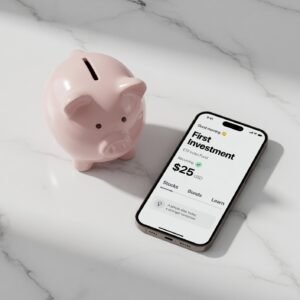
Many people believe that you need thousands of dollars in the bank before you can consider yourself an “investor.” In 2026, this couldn’t be further from the truth. With the rise of commission-free trading platforms, fractional shares, and automated investment apps, your first $100 is more than enough to step into the financial markets.
The most important aspect of investing isn’t the amount of money you start with; it is the habit of investing itself. Starting with $100 builds momentum, teaches you how the markets function, and allows time—the investor’s greatest asset—to begin compounding your capital.
Is $100 Actually Enough to Start?
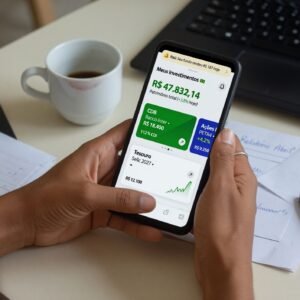
Yes. In the past, high account minimums and steep trading fees effectively locked out the average person from the stock market. Today, those barriers have largely vanished. Many brokerage firms now allow you to open an account with zero minimum deposit and purchase “fractional shares,” which means you can own a piece of high-priced companies even if you only have a few dollars to spare.
Think of that first $100 as the “seed capital” for your financial future. While it won’t make you a millionaire overnight, it will launch the engine of compound interest. Over years and decades, consistent contributions to that initial investment will transform small, regular savings into a substantial portfolio.
The First Priority: Building Your Foundation
Before you dive into the stock market, ask yourself: Is this $100 “investable” money, or is it “emergency” money? If this $100 represents your entire savings, it might be better served in a High-Yield Savings Account (HYSA).
An HYSA acts as your financial shock absorber. It ensures that if an unexpected car repair or medical bill pops up, you won’t be forced to sell your long-term investments at a loss. Once you have a basic emergency fund—even if it starts as just $100—you can then confidently move on to higher-growth assets.
The Best Investment Vehicles for Your First $100
Once you are ready to invest, you need to choose where to put your money. Here are the most effective, low-barrier options for beginners:
1. Exchange-Traded Funds (ETFs)
ETFs are arguably the most powerful tool for a beginner with a limited budget. An ETF is a “basket” of stocks or bonds that trades like a single share. When you buy one share of an S&P 500 ETF, you are instantly buying a tiny piece of the 500 largest companies in the United States. This provides immediate diversification, reducing the risk that comes with trying to pick individual winning stocks.
2. Robo-Advisors
If you don’t want to spend time researching stocks or managing your portfolio, a robo-advisor is an ideal solution. These automated platforms ask you a few questions about your age, goals, and risk tolerance, and then build a diversified portfolio for you. They automatically rebalance your investments and keep your costs extremely low, making them perfect for “set it and forget it” investors.
3. Fractional Shares
If you have your eye on a specific company but the share price is higher than $100, fractional shares allow you to buy, for example, 0.5 or 0.1 shares of that stock. This democratizes the market, letting you invest in the companies you believe in without needing to buy a full, expensive unit of stock.
4. Dividend Reinvestment Plans (DRIPs)
Many stocks and ETFs pay dividends—small cash payouts distributed to shareholders periodically. By setting up an automatic dividend reinvestment plan, you can instruct your brokerage to automatically use those payouts to buy more shares. This is a classic “autopilot” way to accelerate your compounding without any extra effort on your part.
The Strategy: Dollar-Cost Averaging
The biggest mistake beginners make is trying to “time” the market—waiting for the perfect moment to buy when prices are low. The problem is that no one, not even professional analysts, can reliably predict the market’s movements.
Instead, use a strategy called Dollar-Cost Averaging (DCA). This simply means investing a fixed amount of money at regular intervals—like $100 every month—regardless of whether the market is up or down.
-
When prices are high: Your $100 buys fewer shares.
-
When prices are low: Your $100 buys more shares.
Over time, this strategy smooths out the ups and downs of the market and ensures you are consistently building your position.
Common Pitfalls to Avoid

As you begin your journey, guard against these common beginner traps:
-
Chasing “Hot” Trends: Avoid speculative assets, day-trading groups, or “get-rich-quick” schemes. These are often driven by hype rather than solid fundamentals and can lead to quick losses.
-
Ignoring Fees: Always check the expense ratio of an ETF or the management fee of a platform. Even a 1% fee might sound small, but over 30 years, it can reduce your final returns by thousands of dollars.
-
Checking Your Balance Too Often: The stock market fluctuates daily. If you are a long-term investor, checking your portfolio every hour will only increase your stress and tempt you to make impulsive decisions. Stick to your plan.
The Long-Term Mindset: Thinking in Decades
Investing is a game of patience. If you invest your first $100 today in a diversified index fund, the goal is not to see it become $110 next week; the goal is to see it become a cornerstone of your retirement or your financial freedom 20 or 30 years from now.
Compounding is slow at first. Your $100 might only earn a few dollars in interest in the first year. But as that base grows and you continue to add your monthly contributions, the growth starts to compound exponentially. Albert Einstein famously called compound interest the “eighth wonder of the world,” and the sooner you start, the more powerful it becomes.
Final Steps to Get Started Today
If you are ready to put that $100 to work, follow this simple checklist:
-
Open a Brokerage Account: Look for a reputable, low-cost platform that offers commission-free trades and fractional shares.
-
Define Your Goal: Are you saving for a house, retirement, or general wealth? Your goal determines your risk level.
-
Choose Your Core Investment: For most beginners, a broad-market index fund or an ETF is the most reliable, efficient starting point.
-
Automate Your Future: If possible, set up an automatic transfer from your bank account to your brokerage account. Even if it’s just $25 or $50 a month, automation is the key to building the “habit” of investing.
You have already taken the hardest step: deciding to start. By turning that first $100 into a lifelong habit, you are no longer just a spectator in the financial world—you are a participant in your own future. Keep it simple, stay consistent, and let time do the heavy lifting for you.