What would I do if I only had R$1,000 to invest?

image for illustrative purposes only.
The question “What would I do if I only had $1,000 to invest?” is one of the most common inquiries among aspiring wealth builders. It’s a powerful thought experiment because it strips away the complexity of managing massive portfolios and forces us to return to the core principles of finance. If you had $1,000 today, would you chase a “get-rich-quick” stock, put it in a savings account, or perhaps use it to learn a new skill?
The reality is that $1,000 is a significant amount of “seed capital.” It is enough to open an account, start a habit, and—most importantly—build the momentum required to generate long-term financial independence. Here is the exact, step-by-step strategy I would use to deploy that capital effectively, focusing on security, growth, and the most valuable asset you own: yourself.
Step 1: The Critical First Hurdle – The Emergency Buffer
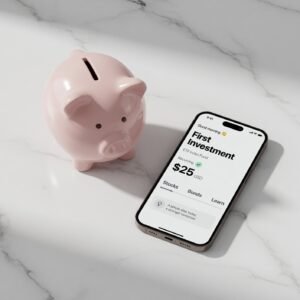
Before a single dollar of that $1,000 is moved into the volatile stock market, I have to ensure the foundation is secure. If you invest $1,000 and an unexpected car repair or medical bill hits next week, you will be forced to liquidate your investment—likely at a loss—just to survive.
I would deposit $500 of that total into a High-Yield Savings Account (HYSA). This acts as my “safety net.” While it won’t yield massive returns, it is liquid, safe, and protected by FDIC insurance. Knowing that I have $500 available for emergencies provides the psychological stability to keep my remaining $500 invested for the long term without panic-selling when the market dips.
Step 2: The Best Investment for Beginners – Yourself
With the remaining $500, my focus shifts. Many beginners make the mistake of thinking that $500 in the stock market will turn into $50,000 in a year. In reality, a 10% annual return on $500 is only $50. That is a fine start, but it isn’t life-changing.
However, using that $500 to increase my earning capacity is life-changing. I would spend a portion of that capital on professional development. This could be:
-
Certifications: Obtaining a license or certification in my field that qualifies me for a higher-paying role.
-
Skill Acquisition: Taking an advanced course in data analysis, digital marketing, or technical writing—skills that have high demand in the freelance or corporate marketplace.
-
Niche Tools: Buying the software or hardware required to start a side project or business.
If I can use $500 to increase my monthly income by even $100, that is a 240% annual return on investment. No stock on Wall Street can guarantee that kind of growth. Increasing your earning power is the most reliable way to accelerate your investment journey.
Step 3: Deploying the Remaining Capital – The Power of Index Funds
Once my emergency buffer is set and I have invested in my own skills, I would take the remaining capital—or any funds I save from my increased income—and open a brokerage account to invest in a low-cost, broad-market index fund (or ETF).
By purchasing an S&P 500 ETF, I am not trying to pick the “next Apple” or “next Bitcoin.” Instead, I am buying a tiny, diversified piece of the 500 largest, most profitable companies in the United States. This is a “set and forget” strategy. I am not checking the charts every day. I am not watching the news. I am simply trusting the long-term historical upward trend of the global economy.
Step 4: Automating the Habit
The most important part of this entire plan is not the initial $1,000; it is the $100 (or whatever I can afford) that I add every single month thereafter. Consistency is the secret ingredient to wealth.
If I treat investing like a utility bill—something that gets paid automatically the moment my paycheck hits—I remove the temptation to spend that money on consumption. This is the “Pay Yourself First” principle. By the time I have invested for a few years, my consistent contributions will far outweigh the impact of that first $1,000.
Why You Should Ignore “Hot” Tips
When you only have $1,000, the temptation to gamble is high. You might hear about a volatile cryptocurrency, a penny stock, or an options trading strategy that promises to turn your $1,000 into $10,000 in a month.
I would strictly avoid these. Speculation is not investing; it is gambling. When you are building your first $1,000, you cannot afford to lose it. Protecting your capital is job number one. Once you have a larger portfolio and a higher income, you can afford to allocate a tiny, “fun” percentage to speculative assets, but for your first $1,000, stick to the tried-and-true boring, broad-market assets.
The Mathematical Miracle of Compounding
Even with small amounts, the math of compounding is undeniable. If you start with $1,000 and add $200 a month at a 7% annual return, after 20 years, you will have over $100,000.
Most people quit because they don’t see results in the first six months. They expect their $1,000 to turn into a fortune immediately. But compounding is like a snowball rolling down a hill—it starts out small and slow, but by the time it reaches the bottom, it is unstoppable. Your job is to make sure you are still rolling that snowball ten years from now.
Evaluating Your “Cost of Living” vs. “Cost of Growth”
Part of the process of managing your first $1,000 is auditing your lifestyle. If you find it difficult to save the next $100 to add to your portfolio, you don’t necessarily have an “investment problem”—you have a “lifestyle problem.”
I would use this $1,000 challenge as an excuse to audit my monthly expenses. Are there subscriptions I don’t use? Are there habits that are draining my capital? Every dollar I save on unnecessary consumption is a dollar I can redirect into my index fund. Treating your personal budget like a business balance sheet is the fastest way to find “hidden” money.
Tax-Advantaged Accounts: The Hidden Advantage

If I were in the United States, I would look closely at where I am holding this $1,000. If this is for retirement, I would prioritize a Roth IRA. In a Roth IRA, your money grows tax-free, and you can withdraw it tax-free in retirement.
Using a tax-advantaged account is like getting a bonus on your returns. If you have the choice between a standard brokerage account and a tax-advantaged retirement account, the retirement account will almost always be the superior choice for long-term growth.
The Psychological Value of the First $1,000
Beyond the numbers, the first $1,000 has immense psychological value. It changes how you view the world. You move from being a “consumer”—someone who gives money to companies in exchange for products—to an “owner”—someone who owns a piece of the companies producing those products.
Once you own that piece of the economy, you start paying attention to business news. You start understanding why interest rates matter. You start seeing the world as an interconnected web of trade and value. This shift in perspective is just as valuable as the money itself, because it prepares you to handle the larger amounts of capital you will inevitably manage in the future.
Start Simple, Start Today
If you have $1,000 today, don’t wait for the market to be perfect. Don’t wait for the “best” time to enter. The best time to start is when you have the capital and the plan.
-
Safety First: Keep your emergency buffer in an HYSA.
-
Growth Second: Invest in your own skills to raise your income.
-
Market Exposure Third: Use a low-cost, broad-market index fund to capture global growth.
-
Consistency Always: Automate your contributions.
This isn’t a secret formula used by hedge fund managers; it is the quiet, boring, highly effective strategy used by the wealthiest people in the world. They don’t look for the “next big thing”; they look for consistent, sustainable, and reliable growth. By following this blueprint, you are setting yourself up to turn that $1,000 into a foundation of wealth that will serve you for the rest of your life. Start today, stay disciplined, and let time work its magic.