Why You Keep Spending Money Even When You Know You Shouldn’t

We have all been there. You sit down at the beginning of the month with a goal: This is the month I finally save. You have the spreadsheet ready, your budget apps are synced, and your intentions are pure. But by the second week, the “Amazon Prime” boxes start arriving, you’ve hit the drive-thru three times more than planned, and that “limited time offer” on a new pair of shoes felt too good to pass up.
Why does this happen? Why is it that even when we are staring at our bank balances with a sense of dread, we still find a way to justify another purchase?
The truth is that overspending is rarely a “math” problem. It is a brain problem. We are living in a 2026 digital landscape specifically designed to hijack our biological weaknesses. If you want to stop the cycle, you have to understand the invisible psychological and neurological forces that are driving your hand toward your wallet.
The Neurochemistry of the “Buy” Button: Dopamine vs. Satisfaction
To understand why we spend, we first have to look at the brain’s reward system. Many people believe we spend money because we want the item we are buying. However, neurobiology tells a different story.
The Dopamine Anticipation Loop
When you see something you want—whether it’s a new gadget or a designer bag—your brain releases dopamine. Interestingly, dopamine is not the “pleasure” chemical; it is the “craving” chemical. Its job is to motivate you to get the thing, not to make you happy once you have it.
The highest spike of dopamine occurs during the anticipation phase. Research shows that scrolling through an online store and clicking “Add to Cart” provides a much higher chemical hit than actually opening the package three days later. This is why we often feel a “shopper’s hangover” or buyer’s remorse shortly after a purchase. The chemical high has vanished, leaving you with a drained bank account and an object you didn’t actually need.
Emotional Regulation: Is Your Spending Actually “Retail Therapy”?

We often joke about “retail therapy,” but for many, it is a primary mechanism for emotional regulation. When we feel out of control in our personal or professional lives, spending money provides an immediate (though temporary) sense of agency and power.
Spending as a Response to Stress and Sadness
When we are stressed, our bodies are flooded with cortisol. Spending acts as a “quick fix” to counteract that stress.
-
The “I Deserve This” Trap: After a hard day at work, your brain looks for a reward to compensate for the suffering. This is where the “I worked hard, so I deserve this $\$100$ dinner” logic comes from.
-
The Loneliness Gap: Studies have shown that people who feel socially isolated are more likely to pursue “materialistic” acquisitions to fill an emotional void.
The danger is that emotional spending creates a feedback loop. You feel bad, so you spend. Then you feel bad because you spent, leading to more spending to soothe the new guilt.
Decision Fatigue: Why You Overspend at the End of the Day
Have you ever noticed that you are much more likely to buy something you shouldn’t at 9:00 PM than at 9:00 AM? This is due to a phenomenon called Decision Fatigue.
The Depletion of Willpower
Willpower is like a muscle; it gets tired the more you use it. Every time you make a choice—what to wear, what to eat for lunch, how to respond to a difficult email—you use up a small amount of your cognitive energy.
By the time the evening rolls around, your Prefrontal Cortex (the logical, decision-making part of the brain) is exhausted. When your logical brain is tired, your Limbic System (the emotional, impulsive part) takes over. This is why late-night online shopping is such a massive industry. Your brain literally lacks the energy to say “no.”
The “Frictionless” Trap: How Technology Bypasses Your Logic
In the era of physical cash, spending money hurt. Literally. Neuroimaging shows that when people pay with physical bills, the “pain centers” of the brain (the insula) light up. We feel the loss of the money because we can see it leaving our hands.
The Death of the “Pain of Paying”
Modern fintech has worked tirelessly to remove this “pain” from the transaction. Every innovation is designed to make spending frictionless:
-
One-Click Ordering: You don’t even have to enter your address or credit card.
-
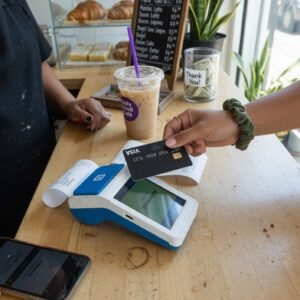
Apple Pay and Google Pay: A simple tap, and the money is gone before you can even think about the total.
-
Buy Now, Pay Later (BNPL): Services like Klarna or Affirm decouple the joy of the purchase from the pain of the payment. By the time the first installment is due, the dopamine hit is long gone.
When you remove the friction, you remove the “stop-and-think” moment that protects your savings.
The Digital Joneses: Social Comparison in the Age of Influencers
We used to compare ourselves to our neighbors. Now, we compare ourselves to the top $0.1% of the world through our smartphone screens.
The Targeted Lifestyle
Social media platforms use algorithms to show you exactly what you are most likely to envy. When you see influencers constantly showcasing new “hauls” or luxury vacations, your brain begins to shift its “baseline” for what is normal.
This leads to Lifestyle Creep. You begin to feel that you “need” certain brands or experiences just to maintain a basic social standing. In the US, this is often driven by a culture of “conspicuous consumption,” where our identity is tied directly to the brands we display.
Dark Patterns: How Marketing Manipulates Your Biology

Have you ever seen a countdown timer on a website saying “Only 2 items left!” or “Deal ends in 10:43”? Often, these are Dark Patterns—user interface designs intended to trick you into doing things you didn’t mean to do.
Artificial Scarcity and Urgency
These tactics are designed to bypass your logical brain and trigger your “Survival Instinct.”
-
Scarcity: “Only 1 left at this price!” triggers a fear of loss.
-
Social Proof: “15 other people are looking at this item right now!” makes you feel like you’re in a race.
-
The “Sale” Illusion: Marking an item down from $100 to $70 makes you feel like you are “earning” $30, rather than “spending” $\$70$.
Marketing agencies spend billions of dollars every year studying how to trigger these specific biological responses. It isn’t a fair fight between you and the “Buy” button.
Money Scripts: The Hidden Childhood Programming
Your relationship with money was likely decided before you ever opened your first bank account. We all have Money Scripts—unconscious beliefs about money that we learned from our parents and our childhood environment.
Identifying Your Script
-
Money Avoidance: The belief that money is “bad” or that you don’t deserve it, leading to “sabotaging” your savings by spending it all.
-
Money Worship: The belief that more money will solve all your problems, leading to a never-ending cycle of consumption.
-
Money Status: The belief that your net worth equals your self-worth.
If you grew up in a household where money was a source of constant conflict or where it was used as a reward for love, you are significantly more likely to use spending as a way to handle emotional stress as an adult.
The Scarcity Mindset: Why Poverty Makes You Spend
There is a common, judgmental myth that people with low incomes are “bad with money” because they make impulsive purchases. However, behavioral science suggests the opposite: the Scarcity Mindset makes spending feel like the most logical choice.
The “Use it or Lose it” Logic
When you live in a state of chronic financial instability, you learn that “extra” money is a temporary illusion. If you don’t spend it now, an emergency—a car repair, a medical bill, a family crisis—will take it away anyway.
Therefore, spending money on a small luxury today feels like a way to “capture” some happiness before the world takes the money back. This is an adaptive survival mechanism that, unfortunately, makes it incredibly difficult to build long-term wealth.
Practical Strategies to Rewire Your Spending Habits

Understanding the “why” is half the battle. The other half is building Friction back into your life. Here is how to fight back against your own biology:
1. The 48-Hour Cooling-Off Rule
Never buy anything non-essential immediately. If you see something you want, put it on a “Wish List” and wait exactly 48 hours. This gives your dopamine levels time to normalize and your Prefrontal Cortex time to wake up. Often, after two days, the “need” for the item has completely vanished.
2. De-Digitize Your Payments
If you find yourself overspending on “little things,” go back to a Cash-Only System for one month for categories like groceries, dining out, and entertainment. When you physically feel the cash leaving your wallet, your brain will start to “feel” the pain of paying again.
3. Identify Your “Hungry, Angry, Lonely, Tired” (HALT) Moments
Before you click “checkout,” ask yourself: “Am I Hungry, Angry, Lonely, or Tired?” If the answer is yes, close the laptop. You are likely trying to solve a biological or emotional problem with a commercial solution.
4. Audit Your Digital Environment
-
Unsubscribe: If you get “Daily Deals” emails, you are being manipulated daily. Unsubscribe.
-
Remove Saved Cards: Delete your credit card info from Amazon, Chrome, and your favorite clothing sites. Forcing yourself to walk to your wallet and type in the numbers creates just enough friction to stop an impulse buy.
Forgiving Yourself and Moving Forward
The most important thing to remember is that you are not a failure. You are a human being with a brain that is being targeted by the most sophisticated marketing machines in history.
Success in 2026 financial life isn’t about having “perfect willpower.” It’s about building a system that protects you from yourself. By understanding your triggers—whether they are emotional, neurological, or technological—you can start to make choices that align with your values rather than your impulses.
Stop looking at the spreadsheet for a moment and start looking at your mind. Once you master your behavior, the math will take care of itself.