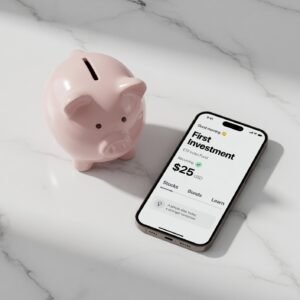
What changes after your first investment?

image for illustrative purposes only.
Most people spend years thinking about investing. They read books, watch market news, listen to podcasts, and browse forums, yet they remain on the sidelines. The psychological barrier to clicking that “Buy” button for the first time is immense. It is the transition from a theoretical observer to an active participant in the global economy.
Once that first order settles—whether it is $10 or $10,000—the entire landscape shifts. The transition is not just about the numbers in your account; it is about a fundamental change in your mindset, your relationship with money, and your perception of the world around you. Here is what happens when you finally stop watching and start doing.
The Psychological Shift: From “Saving” to “Growing”
Before your first investment, your primary financial relationship is with “saving.” You view money as a resource to be protected and kept safe in a bank account. While saving is a vital habit, it is purely defensive. You are protecting your capital against immediate loss, but you are not actively putting it to work.
After your first investment, you begin to think in terms of “deployment.” You start to see money as a tool that has the potential to generate more of itself. This is the moment the “investor mindset” clicks into place. You start to realize that every dollar you don’t spend is an employee that can work for you 24/7. This shift from defensive saving to offensive wealth-building is the single most significant change in your financial journey.
The Death of the “Market Mystery”
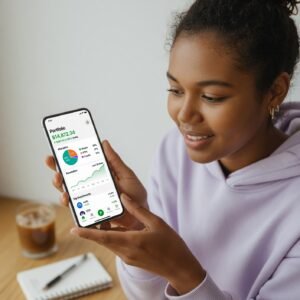
One of the most profound changes after your first investment is the evaporation of the “mystique” surrounding the financial markets. Before you participate, the stock market feels like a chaotic, complex entity controlled by people in suits on Wall Street.
Once you own even a fractional share of a company or an index fund, that perception dies. You realize that the market is simply a collection of businesses selling products and services you likely use every day. When you see news about inflation, supply chains, or interest rates, it is no longer abstract information. It is information that directly impacts the assets you own. You start paying attention to the world differently because you have “skin in the game.”
The Birth of the Compounding Habit
The most practical change that occurs after your first investment is the ignition of the compound interest engine. Many beginners make the mistake of waiting for a “large” amount of money to invest. The truth is that the greatest impact of your first investment isn’t the return it generates in the first month; it is the fact that it makes a second investment inevitable.
Once you see your portfolio update—even if it is just by a few cents or dollars—you are suddenly incentivized to contribute more. You start looking for ways to trim your monthly budget, not just to save money, but to “buy more assets.” Your budget, which once felt like a list of sacrifices, suddenly transforms into a list of opportunities to purchase your future freedom.
How Your Consumption Habits Will Naturally Evolve
After your first investment, you will likely notice a change in your consumption habits that you didn’t anticipate. When you are a non-investor, money is just “currency” to be traded for goods or services. When you are an investor, you start to view purchases through the lens of “opportunity cost.”
You might find yourself walking through a store and thinking, “If I don’t buy this $50 item today, I could invest that $50 instead.” This isn’t necessarily about living a life of misery and deprivation; it is about intentionality. You become a better consumer because you are constantly weighing the temporary joy of a purchase against the permanent benefit of an investment. This is not a “sacrifice”; it is a recalibration of what you value most.
The Change in Your Relationship with Risk
Many people stay on the sidelines because they are terrified of “risk.” They hear stories of market crashes and assume that investing is akin to gambling. However, after your first investment, you begin to understand the difference between volatility and risk.
-
Volatility: The daily, weekly, or monthly price fluctuations of the market.
-
Risk: The permanent loss of capital or the failure to reach your long-term goals.
You learn that avoiding the market is actually the greatest risk of all because it guarantees that your money will lose value to inflation every single year. After your first investment, you stop being afraid of the “red days” (when the market is down) and start viewing them as opportunities to purchase assets at a discount. Your fear is replaced by a strategy.
The Long-Term Horizon: From Days to Decades
Before investing, your financial planning likely operates in cycles of weeks or months—paycheck to paycheck. After your first investment, your time horizon naturally expands. You are no longer just thinking about how to pay your rent next month; you are thinking about where you want to be in five, ten, or twenty years.
This shift in horizon is a superpower. Most people live their entire lives in the “short-term trap.” When you start investing, you are forced to look at the horizon. You begin to understand that wealth is a long-term byproduct of patience. You become less interested in the immediate gratification of a flashy purchase and more interested in the quiet, consistent growth of your net worth.
What Happens When You See Your First “Return”
The day you see your first dividend payment or the first time your portfolio value increases simply because you held the asset, something profound happens. It is the moment you experience “passive income” for the first time.
Even if that first return is just a few pennies, the psychological impact is massive. It validates the strategy. You stop thinking of investing as a complex math problem and start seeing it as a logical, reliable process. It turns a concept you read about into a tangible reality. It proves that you can make your money grow without having to labor for it. That realization is addictive, and it is what keeps people on the path to financial independence.
Dealing with Market Noise: The New Filter
After your first investment, you will find that you have a new “filter” for the news. Before, you might have felt anxious listening to clickbait headlines about a “Market Crash Imminent!” or “The Next Big Opportunity.”
Now, you have a filter. You quickly learn to ignore the sensationalism. You understand that news is designed to grab your attention, not to help you grow your wealth. You become more discerning, looking for long-term trends rather than daily sensationalism. You start to seek out quality information that helps you refine your strategy, and you start to tune out the noise that only serves to cause panic.
Your First Investment Is Not the Destination
It is critical to remember that your first investment is not the end of the journey; it is the beginning of a life-long habit. The person who invests their first $100 and stops is not an investor; they are just a person who took a one-time risk. The person who invests their first $100 and then continues to invest month after month is an architect of their own future.
Once you have made that first move, the hardest part is over. The friction of the unknown has been replaced by the familiarity of the process. You have a brokerage account, you have a strategy, and you have the experience of having already entered the market. Now, the only thing left to do is to be consistent.
The Ripple Effect on Your Career and Income

Interestingly, many people report that their professional life improves after they start investing. When you are invested in your future, you tend to be more proactive in your career. You look for ways to increase your “human capital”—your skills, your value, and your income—because you know that every extra dollar you earn can be funneled into your growing portfolio.
Investing doesn’t just grow your bank account; it grows your ambition. It connects your daily work to your future dreams. You stop seeing your job as just a way to pay bills and start seeing it as the primary engine that funds your freedom.
The Invitation to Your Future Self
If you are currently waiting for the “perfect moment” to make your first investment, stop waiting. The perfect moment does not exist. The best time to start was yesterday, and the second best time is today.
After your first investment, your life will not look drastically different on the outside—you won’t wake up a millionaire, and your daily routine will stay much the same. But on the inside, everything changes. You stop being a spectator and become a strategist. You stop being a consumer and become a builder. You stop wondering if you could achieve financial freedom and start knowing how you will achieve it.
That first step is the bridge between the life you have and the life you want. Cross it, and don’t look back.